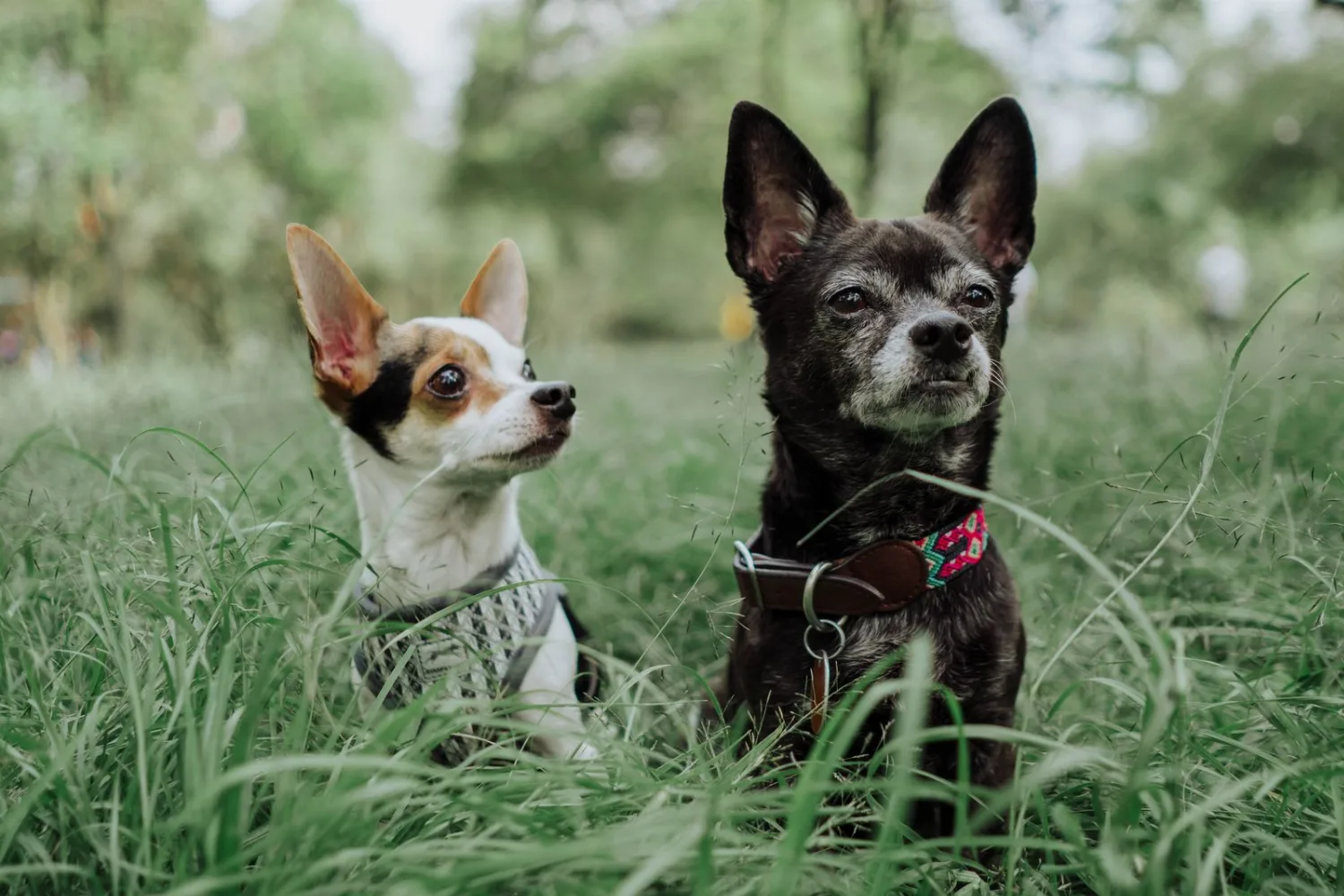
There is a running joke in chihuahua circles, and I have yet to find the household that disproves it: nobody stays at one. The breed comes with its own gravity; the second dog arrives within a couple of years of the first, and the third gets rationalized in ways that would not survive an audit. Our own team wrote about that arithmetic in the owner's briefing, under the heading one puppy has a way of becoming three.
The joke is affectionate, but the decision underneath it deserves better than momentum. A second chihuahua can be the best thing that ever happens to your first one; it can also double a problem you have not solved yet. Here is how to tell which household you are.
Quick answer: A second chihuahua can be the best thing that ever happens to your first, or it can double a problem you have not solved. It will not fix separation anxiety, which is distress about your absence specifically. Opposite-sex pairings with both dogs altered have the fewest conflicts on average, two females are the pairing most prone to serious friction, and individual temperament outranks all of it. Many chihuahuas are visibly more comfortable with their own size than with larger dogs.
Why pairs genuinely work in this breed
Chihuahuas are companion dogs to the marrow, and while their favorite companion is you, most enjoy the company of their own kind; the breed famously prefers other chihuahuas, the kind of clannishness that makes two of them curl into a single warm knot in one bed.
A pair keeps each other warm (a real consideration for a heat-losing four-pound body), plays at a matched scale where nobody gets flattened, and gives the anxious hours when you leave the house a companion who speaks the same language. Multi-chihuahua homes are not a meme by accident; they are the breed working as designed.

What a second dog will not do
Now the myth that fills return kennels. A second chihuahua does not cure the first one's separation anxiety; a dog in genuine panic about your absence is panicking about you, not about being the only dog in the room, and the distinction matters.
It does not fix untrained barking either; it doubles the choir, because the new dog learns the house rules from the resident expert. The ASPCA's behavior guides are blunt about treating behavior problems at the source, and the source is never addressed by adding a witness. Rule of thumb: a second dog multiplies whatever you already have. Multiply something worth multiplying.
The readiness audit
Four questions, answered honestly. Is the resident dog trained to a level you would be content to see duplicated? Is she actually dog-friendly, not just dog-tolerant at a distance on walks? Can the budget carry two of everything, including the dental cleanings that small breeds collect like stamps?
And do you have the two to four weeks of managed introductions in you, gates, separate feeding stations, supervised sessions, before the two of them can be trusted to negotiate a sunbeam? Four yeses and you are the household the joke was written about. Any no is your to-do list, and it is cheaper to finish it with one dog than with two.
Choosing and introducing number two
Opposite-sex pairs have the smoothest track record, and if you are weighing that question our male versus female guide covers it; matched energy matters more than matched age, though a bouncing adolescent and a creaky senior is a mismatch on its face.
Adopting an adult from a rescue has a specific superpower here: many rescue chihuahuas already live in foster homes with other small dogs, which means someone can tell you, from observation rather than hope, how this particular dog handles roommates. Introduce on neutral ground, walk them parallel before they share a floor, keep meals separate for weeks, and let the resident dog keep her privileges; the newcomer earns hers on a schedule set by the dogs, not the calendar.
Frequently asked questions
Will a second chihuahua help my dog's separation anxiety?
Usually not. True separation anxiety is distress about your absence specifically, and a companion rarely changes it. Treat the anxiety first, with training and professional help if needed; add a second dog because you want one, not as therapy equipment.
Should the second chihuahua be male or female?
Opposite-sex pairings, with both dogs altered, have the fewest conflicts on average. Two females are the pairing most prone to serious friction; two males vary. Individual temperament outranks all of it, which is why an adult with a known history beats a coin flip.
Do chihuahuas prefer other chihuahuas?
Very commonly, yes. Many are visibly more comfortable with their own breed and size than with larger dogs, whose ordinary play can injure them. A same-size companion sidesteps the physics problem entirely.
What if the two dogs do not get along?
Slow everything down and go back to separated routines and parallel walks; most pairs settle with weeks of managed coexistence. A reputable rescue will take a placement back if it truly fails, which is one more argument for adopting through one. Persistent fighting is a case for a professional trainer before a rehoming decision.
Get it right and the payoff shows up on the first cold evening, when you look over at the dog bed and find it double-occupied; two sets of enormous ears, one shared blanket, the smaller dog asleep on the bigger one's spine like it was load-bearing. Nobody warns you about the arithmetic after that. I have never once heard a two-chihuahua household wonder aloud about going back to one; I have heard several of them explain, sheepishly, how they got to four.




No comments yet
Leave a comment