
Every chihuahua household knows the sound. Not the bark; the other one. The air-raid shriek produced when a human foot, traveling at household speed, makes contact with a dog who was, one step ago, verifiably across the room. The scream is instant, operatic, and calibrated to inform every neighbor on the street that you, personally, have committed a crime. This is a guide to what happens next, written by someone with extensive field experience in the apology arts.
The incident, reconstructed
Understand first that the collision is structural. You live with an animal four inches off the ground whose entire strategy, per the velcro file, is to occupy the exact coordinates you will need next. He follows you to the kitchen. He follows you from the kitchen. He is, at all times, deployed at ankle depth in your blind spot, and physics does the rest. Nobody is at fault, which is a sentence exactly one of the two parties involved will accept.
The human apology, and why it fails
My instinct after the yelp was always the full production: swoop down, scoop up, clutch to chest, deliver a monologue of remorse in a pitch normally reserved for lottery wins. This is precisely backwards. To a startled dog, a large mammal lunging down at speed while making high urgent sounds is not an apology; it is a second incident.
The ASPCA's behavior guidance is consistent on the theme that frightened dogs are settled by calm and space, not by intensity, and the trembling that follows a scare, per our shaking file, is adrenaline that needs minutes, not squeezing. First, obviously, check the actual foot: a real limp or a yelp that continues past the moment is a veterinary call, per the emergency file, and at four pounds you check honestly every time. But when the scream was, as usual, theater with excellent production values, the correct apology is boring.
The protocol that works
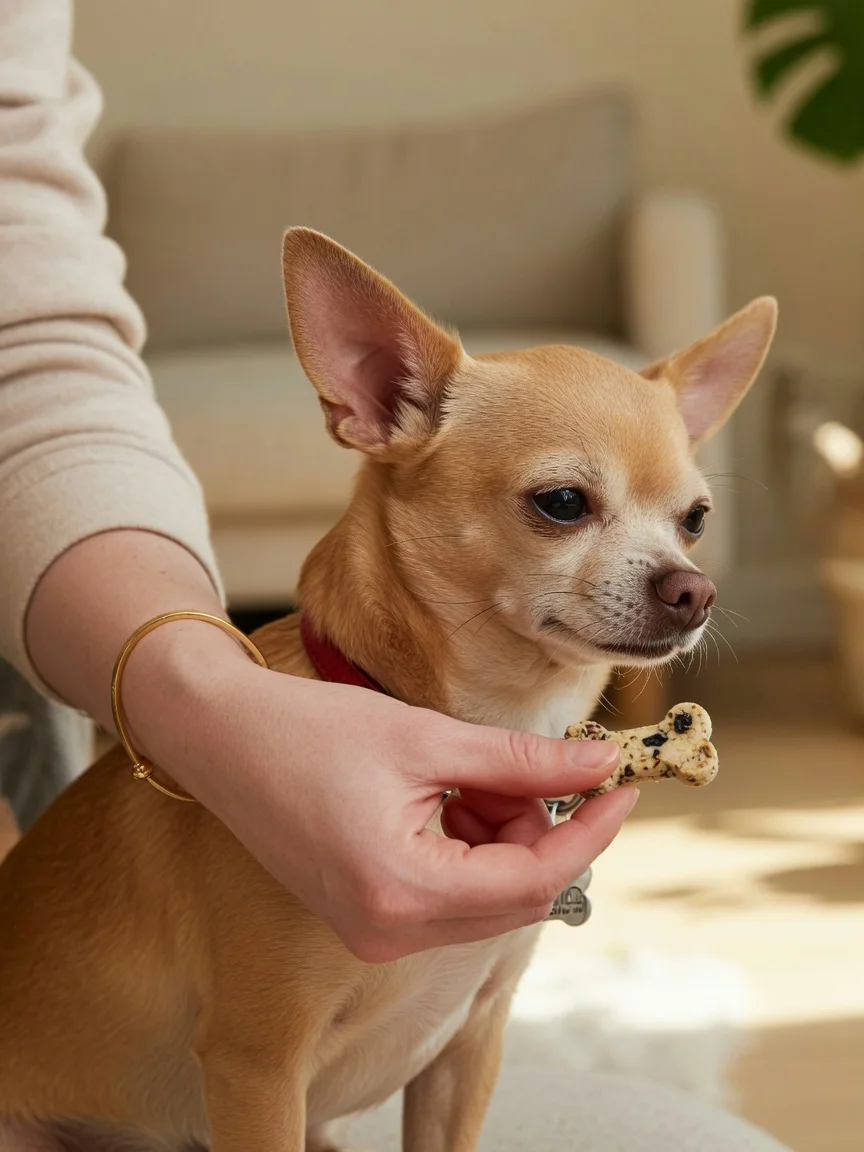
Sit down, at his level, and become uninteresting. Speak once, in your regular voice, the register you would use to discuss weather. Let him complete his own damage assessment, which takes the form of a slow approach, a sniff of the offending foot, and a look I can only describe as insurance adjustment. Then, and only then, reparations: one treat, unceremonial, from the approved schedule, and a resumption of normal programming. The entire process takes four minutes. The dog's forgiveness, once granted, is total, immediate, and without archives, which is the part I find genuinely instructive.
What the dog teaches back
Because here is the asymmetry: Nacho has stepped on me too, at full speed, claws first, sternum height, at six in the morning, and has never once apologized. He has also never held my apology hostage, never brought up the incident during later disputes, and never let a bad moment survive into the next one. Our love-signals desk documents how completely this breed re-commits after every wobble: ten minutes post-incident, he is back on the lap, recompiled, warranty renewed. Humans write essays about how to apologize. Dogs simply reload the relationship from the last good save.
The part of this that is not a joke
Underneath the comedy is the leading household injury for the breed. A four-pound dog who shadows your feet is genuinely at risk from a shin, a rocking chair, a closing door, and the bottom of the stairs in the dark, and the emergency vets who see these cases are not seeing slapstick. They are seeing fractures.
Three habits cut it down. Shuffle rather than step in the kitchen and the hallway, the two rooms where the dog is always underfoot and never visible. Teach a target position, a mat or a specific chair, that pays well and gives her somewhere to be while you cook. And put a light collar bell on her, which sounds absurd until the week it stops you mid-stride twice. If contact does happen, the checklist in our emergency guide is worth reading before you need it: a dog who cries once and then seems fine can still have a fracture, and limping that lasts beyond a few minutes is a same-day call, not a wait-and-see.
The two rooms worth rearranging are the ones where the accidents cluster. Stairs in low light are the first, and a strip of tape or a nightlight on the bottom two treads costs nothing. Doors are the second, particularly the ones that swing back: a dog who follows you everywhere is behind you at exactly the height of the arc, and she will be there again tomorrow. Neither fix is dignified. Both are cheaper than an orthopaedic consult on a leg the width of a pencil.
The standing settlement
So the household now operates under permanent terms. I watch my feet, an atrocity-prevention measure with a documented failure rate. He maintains ankle-depth deployment, unrepentant. The scream remains in the repertoire, undiminished by years of near-misses, and I remain someone who has apologized, out loud, in an ordinary weather voice, to fourteen consecutive pounds of drama across two dogs and one decade. The forgiveness is always granted. The foot placement never improves. The contract, as ever, renews itself at the speed of a wagging tail.


No comments yet
Leave a comment