
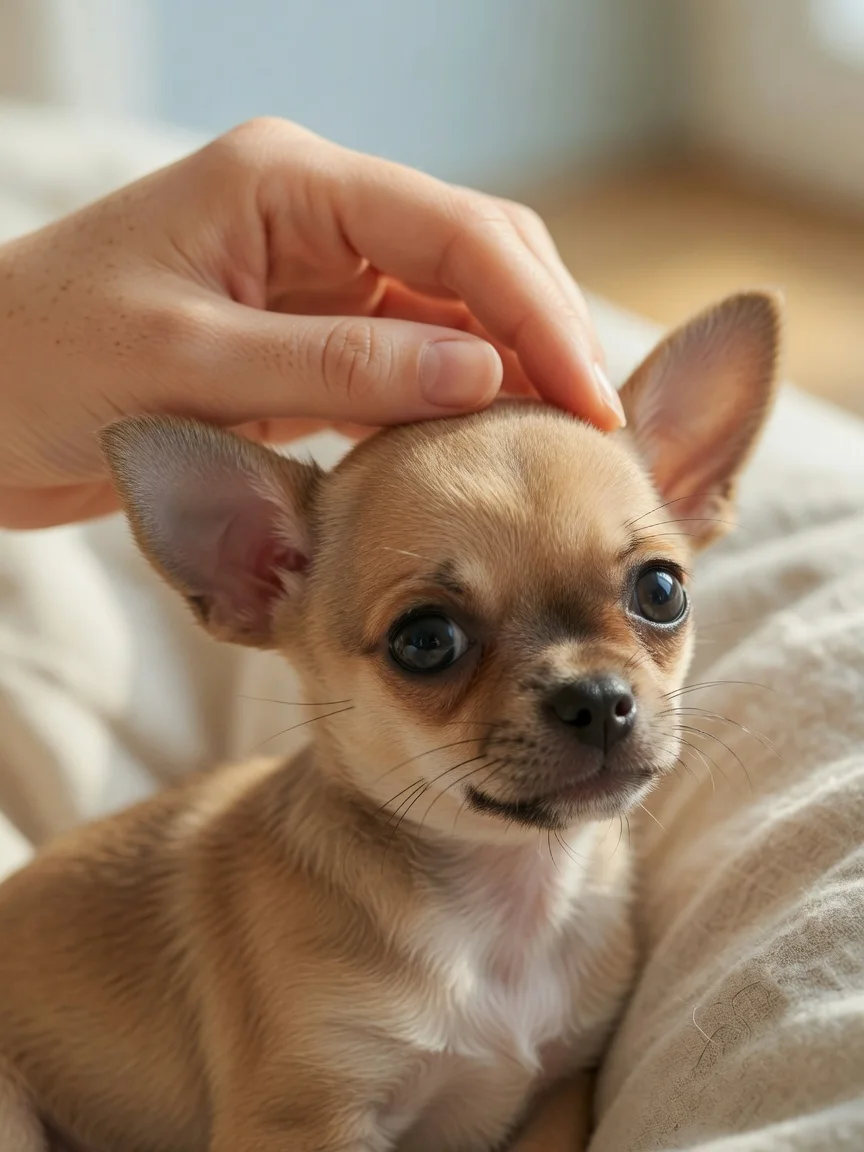
Run a gentle thumb over the top of a chihuahua puppy's head and there is a fair chance you will find it: a small, soft, slightly yielding spot on the crown where the skull feels unfinished. First-time owners tend to discover it by accident and then age five years in one afternoon of searching the internet. So let this article do what that afternoon will not: the soft spot has a name, a long history in this breed, and, by itself, a clean bill of health.
Quick answer: A molera is a fontanel, the same kind of soft spot human babies have: a gap where the skull plates have not yet knitted together, covered by tough tissue rather than bone. The breed's parent club treats it as a normal chihuahua characteristic, and a small, stable soft spot in a healthy dog needs monitoring rather than treatment. Many shrink or close during the first year while some persist at fingertip size for life. It does not mean hydrocephalus, which is a separate problem that happens to share the same real estate.
The molera, translated
The molera is a fontanel, the same kind of soft spot human babies have: a gap where the bony plates of the skull have not yet knitted together, covered by tough tissue rather than bone. Human parents know the plot, and it mostly repeats here: many moleras shrink or close as the puppy matures, typically over the first year or so, while some narrow but persist for life, usually as a small opening the size of a fingertip or less.
What makes the chihuahua version worth an article is how ordinary it is. The molera has accompanied this breed for as long as the breed has existed; historic descriptions treated it as a hallmark, and the Chihuahua Club of America, the breed's parent club, is explicit that a molera by itself is a normal breed characteristic and not a defect or a disease. A persistent small molera in a bright, thriving, neurologically normal chihuahua is a trait, like the big ears, not a diagnosis.
Living with one, which mostly means ignoring it
The covering tissue is sturdier than nerves suggest, and normal life needs no redesign: ordinary petting, grooming, play, and harness wear are all fine. The sensible accommodations are modest. Skip direct firm pressure on the spot, which mostly means telling children and enthusiastic guests that the head is for gentle strokes rather than drumrolls.
Mention the molera to your veterinarian at the first visit so it is on the chart, measured, and tracked like any baseline. Tell the groomer. And protect against head knocks with the same energy you already should for a dog this size, where the real everyday risks are sofa launches and being underfoot, not the soft spot itself.
One genuinely useful twist: an open molera gives your veterinarian an ultrasound window into the skull if a question ever arises, an option big-domed breeds without one do not offer. The gap, in other words, occasionally pays rent.
The condition it gets confused with
Hydrocephalus, water on the brain in the old phrase, is a real and separate condition: cerebrospinal fluid building up inside the skull and pressing on the brain. Toy breeds including chihuahuas are among the predisposed, it is most often congenital and shows itself in puppyhood, and, crucially for this article, it is not caused by the molera. Plenty of dogs with moleras never have it; dogs without moleras can. The confusion persists because severe hydrocephalus can come with a notably domed skull and a larger-than-usual soft area, which is a resemblance, not an equation.
What earns attention is never the spot alone but the dog attached to it. The signs worth knowing: a puppy dramatically slower to learn than littermates, house-training that never takes hold, circling or aimless pacing, pressing the head against walls or furniture, eyes angled persistently down and outward, poor coordination, episodes of dullness, or seizures, the emergency playbook for which lives in our seizure guide.
A puppy showing that cluster needs a veterinary workup regardless of what the top of her head feels like; a diagnosed dog has real options, from medication that manages fluid pressure to surgery in selected cases, and mild cases can live full, slightly eccentric lives. This sits on the breed's known-issues map, the one drawn in full in our health problems guide.
When to call your veterinarian
Emergency care now: seizures, collapse, or a sudden dramatic behavior change after any head knock. Same-day call: a molera that seems to bulge or tighten, a puppy whose head shape is visibly changing fast, or any cluster of the neurological signs above. Routine appointment: getting a newly discovered molera examined, measured, and onto the chart, and any slow-burn worries about learning or coordination. Monitor at home: a stable, small soft spot on a bright, coordinated, trainable chihuahua, which is to say, the overwhelmingly common version of this story.
Frequently asked questions
Is a molera bad for a chihuahua?
By itself, no. The breed's parent club classifies the molera as a normal chihuahua characteristic, and a small, stable soft spot in a healthy, neurologically normal dog needs monitoring in the loosest sense of the word: mention it at checkups and otherwise live your lives.
Will my chihuahua's soft spot close?
Many close or shrink substantially during the first year; some persist for life at fingertip size or smaller, harmlessly. Your veterinarian can track it at routine visits, which is all the management a typical molera ever requires.
Can I touch the molera, and can it be injured?
Gentle everyday contact, petting, grooming, bath-time, is fine; the covering tissue is tougher than it feels. The reasonable precautions are avoiding deliberate firm pressure and treating serious head knocks in any chihuahua, molera or not, as same-day veterinary questions.
Does a molera mean my chihuahua has hydrocephalus?
No. They are separate things that happen to share real estate: the molera is a normal skull gap, hydrocephalus is abnormal fluid pressure, and neither causes the other. The distinction lives in the dog's behavior and development, which is exactly what a veterinary exam sorts out if any of the warning signs appear.
The soft spot is the breed handing you one small anatomical heirloom and a lesson in reading the whole dog rather than one square centimeter of her. Log it, protect it from drumrolls, and let the bright, busy animal underneath it tell you, accurately, that all is well.




No comments yet
Leave a comment