
Socialization is the most misunderstood word in dog raising. It does not mean maximum exposure, dog parks at eight weeks, or passing the puppy around a party like an appetizer. It means accumulating good experiences with the world, at an intensity the dog can handle, during the window when her brain files them as normal. Done right, it is the single best predictor of the confident, portable, unbothered chihuahua everyone wants. Done wrong, or skipped because she fits in a handbag, it manufactures the shouty, terrified stereotype our aggression guide spends its whole length dismantling.
Quick answer: Socialization does not mean maximum exposure, or dog parks at eight weeks. It means accumulating good experiences at an intensity the dog can handle, during the sensitive period of roughly three to fourteen weeks when novelty gets filed as normal rather than threatening. Start immediately with managed, low-risk exposures rather than waiting for the full vaccine series, which wastes most of the window. Mixed-size dog parks are the highest-risk venue for a small dog. Adults can still progress, more slowly and with humbler ceilings.
The window, and why it outranks disease worry
Puppies run a sensitive period, roughly three to fourteen weeks, when novelty is filed as normal rather than threatening; after it closes, new things default to suspicious and change costs far more work. This is why the AVSAB's position statement on puppy socialization is blunt: socialization should begin before the vaccine series finishes, using sensible risk management, clean floors, carried outings, vaccinated adult dogs, puppy classes that check vaccine records, because behavior problems from under-socialization are a far greater lifetime risk to dogs than the diseases owners fear in week ten. Your veterinarian helps you draw the line for your area; the line is never wait until sixteen weeks and hope.
What good socialization looks like
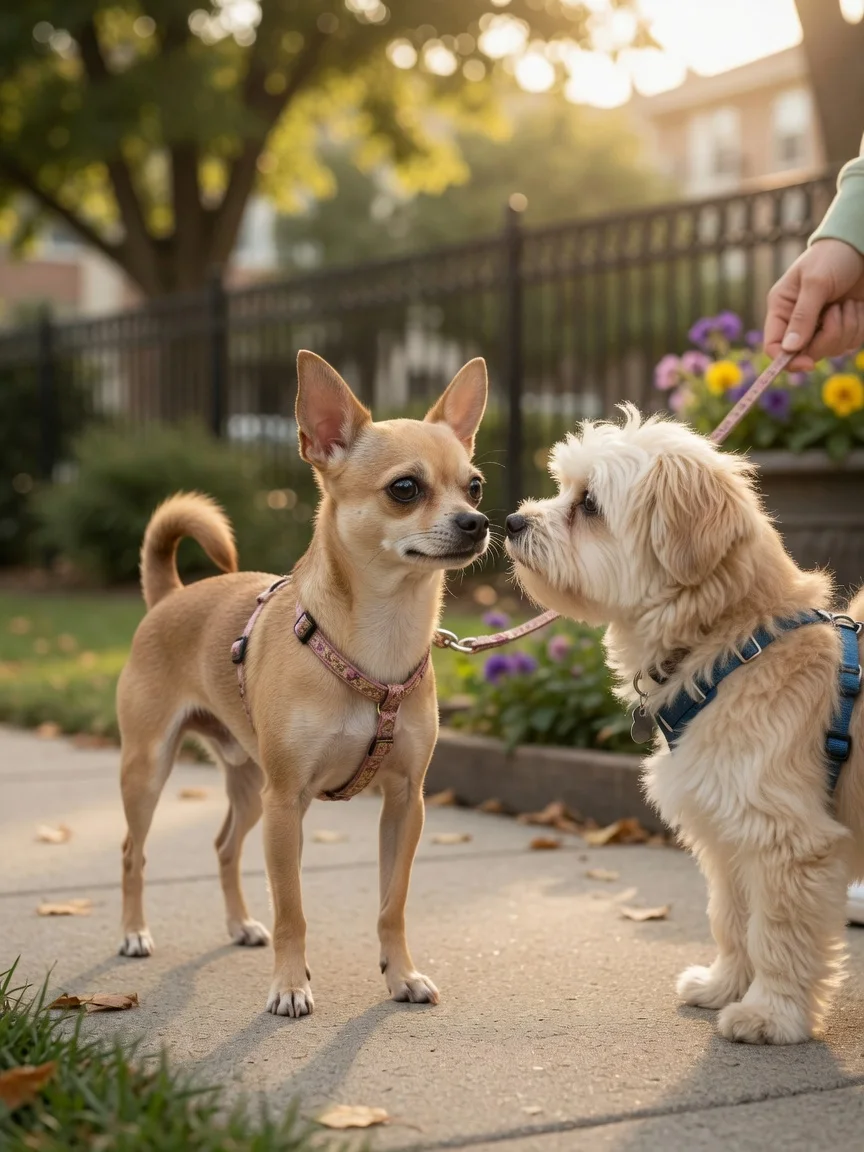
Quality over quantity, always. One calm, treat-paired encounter with a gentle stranger beats twenty overwhelming ones. The formula for every exposure: she notices the new thing at a distance she can handle, good food happens, the thing goes away or she gets to retreat, repeat closer over days. Watch her body, not the checklist: loose and curious means proceed; tucked, frozen, or shouty means you overshot and the fix is distance, not endurance, the same threshold rule as the fearful-dog guide.
The menu is bigger than dogs and people. Surfaces, sounds, traffic, umbrellas, hats, wheelchairs, children at a distance, car rides, the groomer's table, being gently handled everywhere, per the checklist spirit of the American Kennel Club's socialization guide. For a chihuahua, add the small-dog specials: being picked up politely, seeing the world from the floor and not just from arms, and meeting calm, size-appropriate dogs rather than the whole gymnasium.
Feet on the ground. The breed's besetting socialization sin is the permanent carry: a puppy who experiences everything from shoulder height learns nothing about negotiating the world and plenty about being helpless in it. Carry for genuine hazards, absolutely, per the big-dog protocol in our leash guide; walk her the rest of the time and let her earn the confidence, which is the whole velcro-prevention program from another angle.
Choose dog friends like you would babysitters. One calm small or medium dog with good manners is worth fifty dog-park lottery tickets, and at four pounds the lottery has real downside. Parallel walks, controlled sniff-and-part meetings, and a standing playdate with a proven gentle friend build the social skills; chaotic mixed-size scrums build the opposite.
The adult catch-up plan
Missed the window, adopted an adult, inherited a spicy three-year-old? The same machinery works, slower, under a different name: desensitization and counterconditioning, distance plus food plus patience, one category at a time, strangers first or dogs first depending on her file. Progress is measured in months and is genuinely achievable; ceilings exist, and a rescue who reaches politely-neutral rather than gregarious has completed the assignment. The rescue-adoption guide and fearful-dog guide carry the full program, and connecting bites or zero-progress months are the referral criteria, through your clinic, to a reward-based professional.
When to call your veterinarian
Before week twelve: to build the early-outings risk plan and find vaccine-checked puppy classes. Same-day call: any socialization outing that ends with an altercation involving a bigger dog, even without visible wounds; small dogs hide trauma. Ask for a referral: panic-level fear that food cannot touch, or aggression that connects. Training territory: the daily good-experiences curriculum above, run at her pace, forever; socialization has a critical window but no finish line. Crowds are the real test of this work, and putting a chihuahua in a wedding is mostly an exercise in planning around strangers, heat, and noise.
Frequently asked questions
When should I start socializing my chihuahua puppy?
Immediately: the sensitive window runs to about fourteen weeks, and waiting for the full vaccine series wastes most of it. Use managed low-risk exposures, clean floors, carried street time, vetted dogs and classes, with your veterinarian setting the local risk line.
Is it too late to socialize my adult chihuahua?
Too late for the discount window, never too late for progress: adult counterconditioning works, at a slower pace with humbler ceilings. Months of distance-and-cheese work reliably converts terrified to functional and shouty to neutral, which is a life-changing distance in practice.
Should I take my chihuahua to the dog park to socialize her?
Generally no, and especially not as the plan: uncontrolled mixed-size parks are the highest-risk venue small dogs frequent. Curated playdates, parallel walks, and small-dog-only sessions deliver the benefit without the lottery. Socialization is a menu, and the park is its worst dish for this breed.
My chihuahua barks at every stranger. Is that a socialization problem?
Usually a fear-and-payment problem with socialization gaps underneath: strangers predict nothing good, and barking makes them recede. Run the distance-plus-treats protocol from the aggression guide, brief strangers to ignore her, and let approach always be her idea. The bark shrinks as the prediction changes.
Socialization is a bank account: deposits of good experience made early and often, drawn on for the rest of her life every time the world produces a hat, a toddler, or a labrador. Open the account in week eight if you can, open it today regardless, and deposit at her pace, one calm cheese-flavored encounter at a time.



No comments yet
Leave a comment