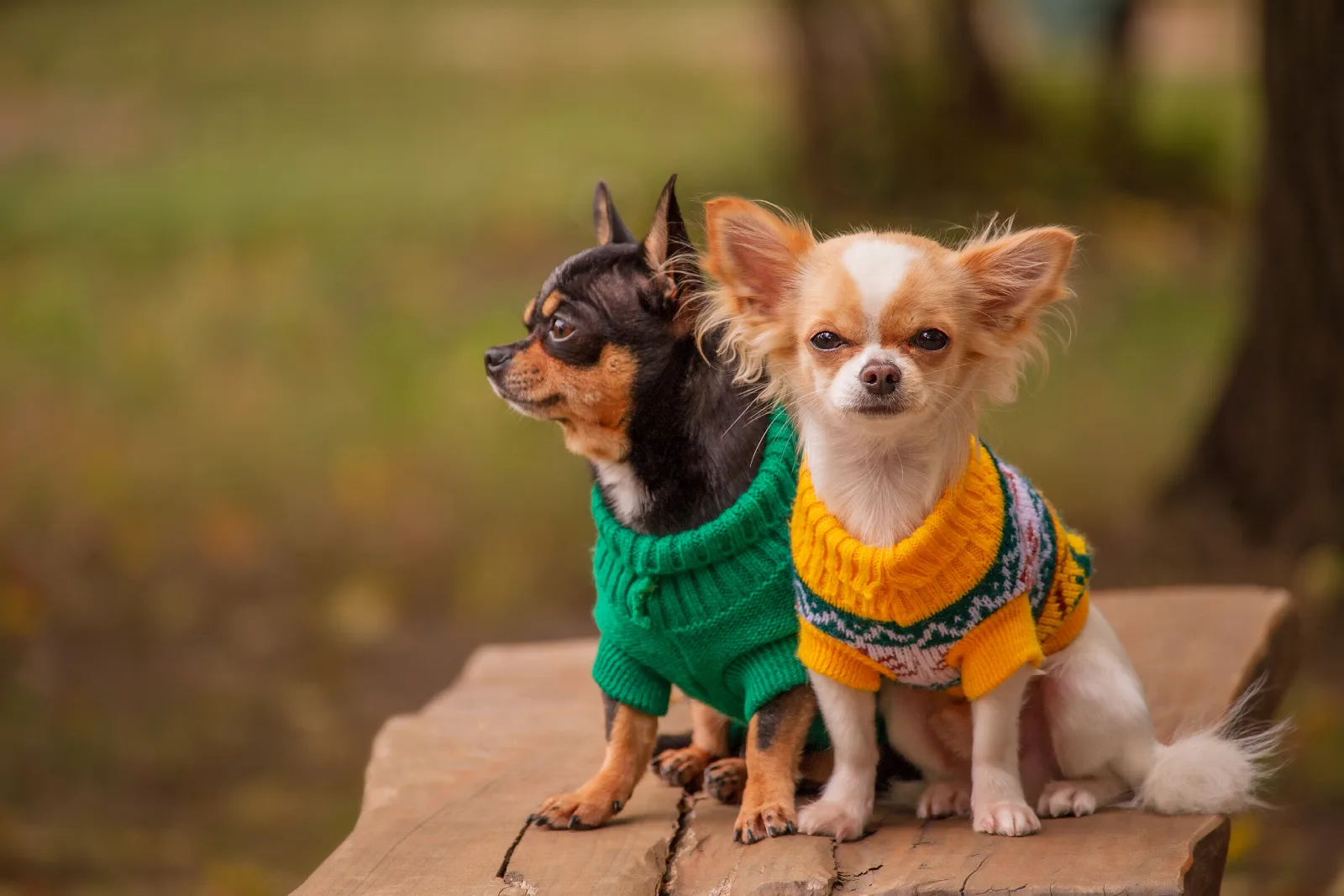
Physics is not on a chihuahua's side in winter. Small bodies have a lot of surface area for very little mass, which means they shed heat quickly and have little insulation to slow the loss. Add short coats, short legs that keep the belly near cold ground, and in many chihuahuas a lean frame with minimal body fat, and you get the least cold-tolerant dog commonly kept as a pet.
None of that keeps a chihuahua from enjoying winter. It just means the owner carries the thermostat. Here is the practical version of where the lines sit, how to read your own dog, and what a sensible cold-weather routine looks like.
Quick answer: As working guidance, sweater territory starts around 60°F (15°C), caution starts around 45°F (7°C), and below freezing is potty-trips-only, with wind, rain, and your individual dog moving those lines. Chihuahuas lose heat faster than almost any other breed, so a well-fitted coat in genuine cold is function rather than fashion. In heat, keep walks short, shaded, and on grass in the mid-80s°F, and skip them around 90°F or lower with heavy humidity.
The practical temperature ranges
There is no official breed-by-breed chart, so treat these as the ranges experienced small-dog owners and veterinary cold-weather guidance converge on, adjusted for your individual dog. Above roughly 60°F (15°C), an ordinary healthy chihuahua needs no help. Between about 45 and 60°F (7 to 15°C), many chihuahuas are happier in a sweater, especially the short-coated, the slim, the very young, and the old.
Below about 45°F (7°C), outings should have a purpose and a time limit, with a proper layer on the dog. Below freezing, you are down to short potty trips and straight back inside. Wind and rain drag every one of those numbers lower, because a wet chihuahua loses heat dramatically faster than a dry one.
The American Veterinary Medical Association's cold-weather guidance makes a point worth repeating: cold tolerance varies dog to dog, so the chart that matters most is the one your own dog writes. Watch her, and adjust.
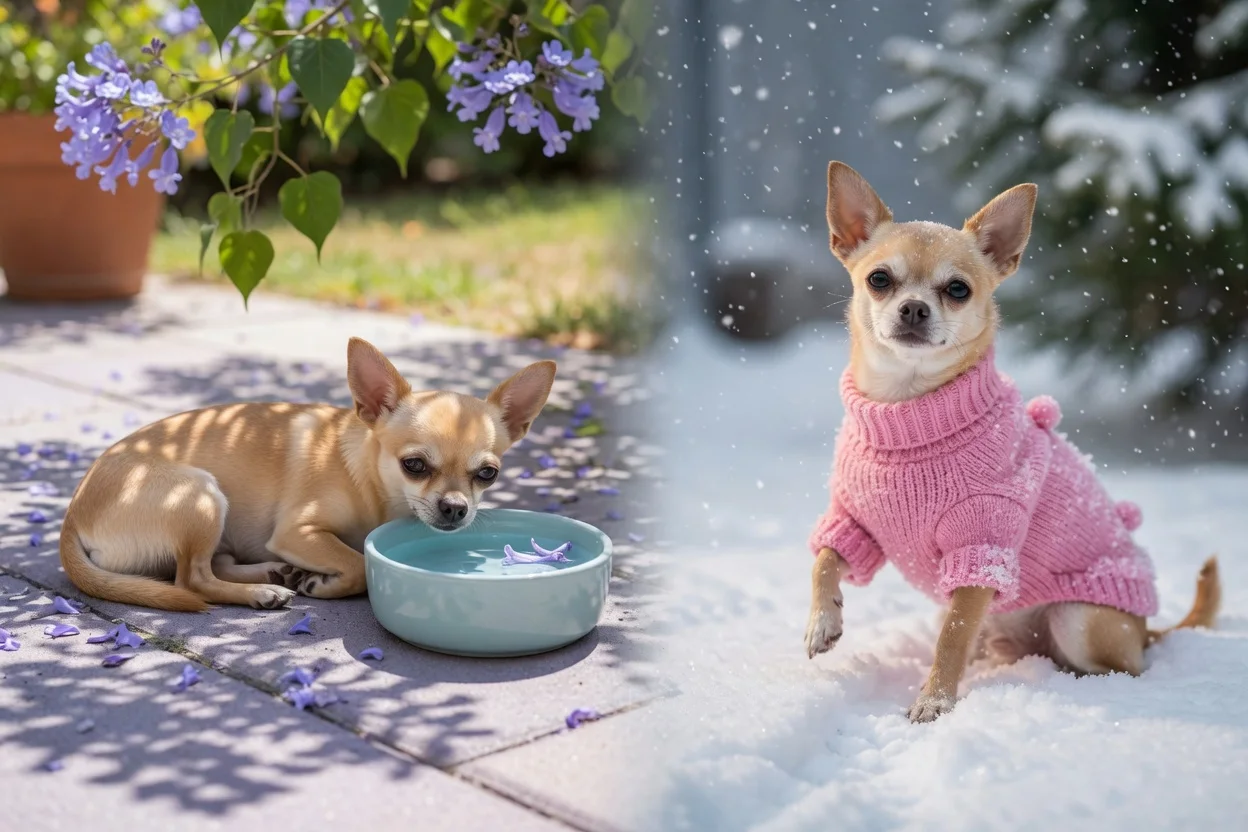
How to read a cold chihuahua
Early signals: shivering, a hunched posture with the tail tucked, lifting paws off the ground, slowing down, whining, and lobbying to be picked up or to turn back. Shivering deserves one clarification, because chihuahuas shake for many reasons; our guide to shaking sorts them out, and cold is the first suspect when the shaking starts outdoors and stops in a warm room.
Serious trouble, meaning hypothermia territory: a dog who has stopped shivering but seems dull, stiff, or uncoordinated, or one who is unusually quiet and cold to the touch. That is an emergency. Warm gradually with blankets and body heat while you call the clinic; do not use direct high heat. Frostbite is the other cold injury, and it favors ear tips, paws, and tail; suspect it if skin looks pale or grey after exposure, and let the clinic assess rather than rubbing the area.
The winter routine that works
A layer that fits. A sweater or coat that covers chest and belly does real work on a dog this size. Fit matters more than fashion: nothing tight in the armpits, nothing dangling. Dry it between walks; a damp sweater is worse than none.
Shorter, more frequent outings. Two ten-minute walks beat one twenty-five-minute march in real cold. Keep moving while you are out; standing around is where the heat loss wins.
Paw care. Road salt and ice-melt chemicals irritate pads and get licked off afterward, so rinse or wipe paws after salted pavement. Snow balls up between toes on long-coated feet; trim the fur there or check as you go.
Warm base at home. Chihuahuas seek heat indoors for the same physics. A draft-free sleeping spot off cold tile, a bed with sides, and a blanket to burrow in cover it. If your house runs cool at night, that is exactly the burrowing you will see; it is normal equipment for the breed.
Watch the calendar's edges. Puppies, seniors, and thin or unwell dogs handle cold worst. A chihuahua puppy in winter combines two risks, because cold burns fuel and tiny puppies carry little; our blood sugar guide explains that pairing. And if your winter plans involve tents and trails, the camping guide covers overnight temperature management in detail.
Can a chihuahua sleep outside?
No. Not this breed, not in any climate with cold nights, and honestly not in warm ones either, for reasons beyond temperature: predators and escape risks scale badly when the dog weighs four pounds. A chihuahua is an indoor dog with outdoor hobbies. Treat any night below room temperature as an indoor night, which for a chihuahua means every night.
The hot side: when warm turns dangerous
The breed's Mexican ancestry gets quoted as heat-proofing, and it is not. A chihuahua cools itself almost entirely by panting, plus a little through the paw pads, and that system falls behind fast in real summer. The working numbers: above roughly 85°F, keep outings short, shaded, and watered; at 90°F or in heavy humidity, make it an indoor day. What should sharpen your attention is where the danger actually comes from. Heatstroke research from the Royal Veterinary College found that exercise, the ordinary walk taken at the wrong hour, is the most common trigger in dogs, well ahead of hot cars. Heavy panting, thick drool, weakness, wobbling, or confusion is an emergency: move to shade, wet the dog with cool (not ice) water, and get to a veterinarian immediately.
The hot-car math
The American Veterinary Medical Association publishes the numbers, and they end every "just five minutes" argument. A parked car climbs about 19°F in ten minutes, almost 30°F in twenty, and more than 40°F within the hour, which turns a mild 70°F afternoon into an interior above 110°F. Cracked windows do not meaningfully change the curve, and hundreds of pets die this way every year. For a dog this size the margin is thinner still, so the rule stays absolute: errands with a car stop mean the chihuahua stays home, in the routine that keeps her comfortable there.
The pavement runs hotter than the air
Air temperature is only half the forecast; the ground writes its own. Cornell's Riney Canine Health Center notes that on a sunny day in the mid-80s, asphalt can reach around 140°F, hot enough to burn paw pads in under a minute, and a chihuahua lives closer to that surface than any breed you will meet. The field test costs nothing: press the back of your hand to the pavement for seven seconds; if you pull away early, the walk moves to grass, shade, or a cooler hour. Early morning and late evening remain the summer schedule.
When to call your veterinarian
Emergency care now: suspected hypothermia, meaning dullness, stiffness, or collapse after cold exposure, or a dog who stopped shivering while still cold. Same-day call: suspected frostbite on ears, paws, or tail, or a dog who seems unwell after a cold outing. Routine appointment: planning winter for a senior, a heart or joint patient, or a puppy's first season. Monitor at home: ordinary shivering that stops promptly indoors, and a healthy dog's normal preference for warm spots.
What owners actually ask
Spend an evening in owner communities and one question repeats in every season: how cold is too cold. The long-running Quora thread on exactly that question lands where the veterinary guidance does, which is reassuring: shivering means the threshold is already behind you, and below about 60°F a sweater stops being fashion. The other evergreen debate, familiar to anyone on r/Chihuahua, is the dog who plainly needs the coat and plainly hates it. The compromise thousands of owners report finding independently is the same one trainers suggest: soft stretchy knits over stiff costumes, short positive sessions with treats, and patience. The forums are worth reading for exactly that reason; they are thousands of households rediscovering the same physics, one shivering four-pound dog at a time.
Frequently asked questions
What temperature is too cold for a chihuahua?
As working guidance: sweater territory starts around 60°F (15°C), caution starts around 45°F (7°C), and below freezing is potty-trips-only. Wind, rain, and your individual dog move the lines, so let shivering and reluctance overrule any number.
Do chihuahuas really need coats, or is it a fashion thing?
For much of the year in mild climates, they need nothing. In genuine cold, a well-fitted layer is function, not fashion, because this breed loses heat faster than almost any other. The dog who fights clothing can often be won over with better fit and treats; start indoors in short sessions.
Why does my chihuahua shiver even when it is not that cold?
Chihuahuas shiver from excitement, stress, and anticipation as well as cold, and a dog can be chilly at temperatures that feel fine to you. If the shivering stops in a warm room and the dog is otherwise bright, it was probably temperature or emotion. Persistent shivering with dullness or other signs belongs at the clinic.
How hot is too hot to walk a chihuahua?
In the mid-80s°F, keep it short, shaded, on grass, with water along. Around 90°F, or lower with heavy humidity, skip the walk and run the energy off indoors. Any day the seven-second pavement test fails, the walk waits for evening. If she starts panting hard or lagging mid-walk, that is the walk telling you it is over.
Is heat dangerous for chihuahuas too?
Yes, in the opposite season: hot cars are lethal, and pavement in summer burns small paws quickly. Heat deserves its own article, but the short rule is shade, water, and no exertion in the heat of the day.
The breed's winter needs come down to respect for arithmetic. Small dog, fast heat loss, simple fixes: a layer, shorter outings, dry paws, a warm bed, and an owner who treats shivering as information. Get those right and winter is just another season with better blankets.


No comments yet
Leave a comment