
Yes, legally and practically: a chihuahua can be a service dog. The Americans with Disabilities Act sets no minimum size and no breed list, and the tasks a service dog performs do not all require shoulders. What a chihuahua cannot do is pull a wheelchair or brace a fall, which means the honest version of this answer sorts service work into the jobs a four-pound dog does well, the jobs she cannot do at all, and the paperwork myth that costs hopeful owners real money. This guide covers all three.
Quick answer: Yes, legally and practically. The Americans with Disabilities Act defines a service animal by training and task, not by breed or size, so there is no weight floor and no approved-breeds list. A chihuahua does alert and response work well: hearing alerts, medical alerts, and psychiatric tasks such as panic interruption. What she cannot do is pull a wheelchair or brace a fall. No registration exists or is required, and online certificates carry no legal standing.
What the law actually says
Under the ADA's service animal requirements, a service animal is a dog individually trained to perform tasks directly related to a person's disability. That is the entire test: disability, training, task. There is no size clause, no weight floor, no approved-breeds list, and, critically, no certification requirement. Businesses may ask only two questions: whether the dog is required because of a disability, and what task it is trained to perform. A trained chihuahua clears that bar exactly as a labrador does, and her public-access rights are identical once she does.
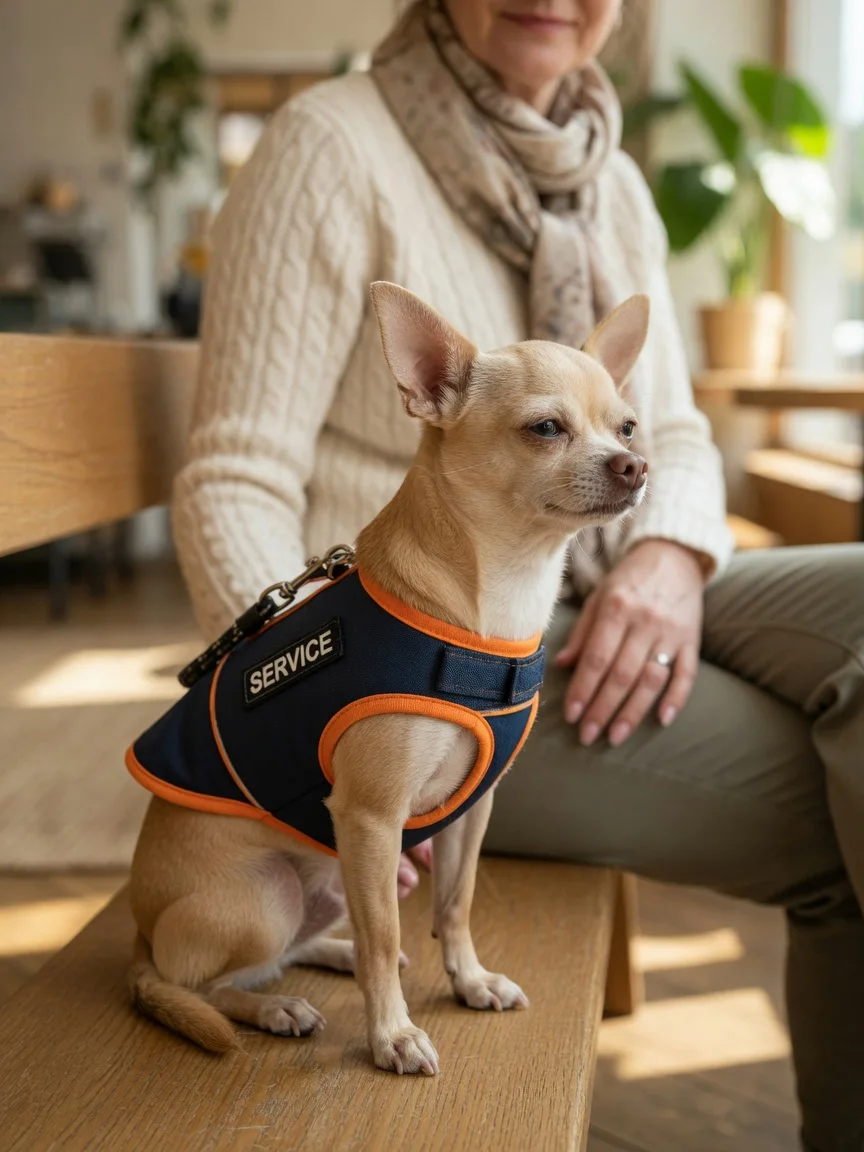
The jobs a four-pound dog does well
Service work at this size is alert work, and the breed brings genuine equipment to it. Chihuahuas are attentive, person-focused dogs with elite hearing, per the alarm-system heritage covered in our ears guide, and they specialize in reading their person, a talent our love-signals guide documents at length.
In practice, small dogs are trained as hearing dogs, alerting deaf and hard-of-hearing handlers to doorbells, alarms, and their name; as medical alert dogs, signaling oncoming episodes for conditions where scent or behavior change precedes the event; and as psychiatric service dogs performing trained tasks like interrupting panic responses or providing grounding pressure on the lap, a job description this breed was practically drawn for. The portability that makes the breed easy to live with, per our fit-test guide, is an asset here: a working dog that rides in a sling reaches places a large dog manages awkwardly.
The jobs she cannot do are the physical ones: guiding, bracing, pulling, retrieving heavy objects, opening doors. No training overcomes the physics, and a reputable program will say so in the first conversation. Temperament is the other honest filter: service work demands calm neutrality in public, and a poorly socialized chihuahua's default is loud opinion, per our reactivity guide. The socialization window covered in the socialization guide matters more for a service prospect than for any pet.
Service dog, emotional support animal, therapy dog: three different jobs
The terms blur constantly, and the legal rights attached to them differ sharply, per the American Veterinary Medical Association's overview. A service dog is task-trained for one handler's disability and has public-access rights under the ADA. An emotional support animal provides comfort by presence, needs no task training, and has no ADA public-access rights, though housing protections may apply under separate rules.
A therapy dog is a volunteer visitor to hospitals and schools, working many people, with access only where invited. A chihuahua can hold any of the three roles; comfort-by-lap is arguably the breed specialty, and the calm ones make beloved therapy visitors. What she cannot do is hold ESA paperwork and claim service-dog access: those rights attach to trained tasks, not to comfort.
The registry scam
The consumer-protection paragraph, because this genre is thick with it: there is no official service dog registry in the United States. The ADA requires no certificate, no ID card, no vest, and no listing in any database, which means every website selling "official service dog registration" is selling a product with zero legal weight. The money in a real service prospect goes to training, whether through a program or owner-training with professional support, and the proof of the work is the work: a dog that performs her task and behaves in public. Skip the laminated card; fund the trainer. Working roles are not limited to assistance either: a six-pound chihuahua mix certified as an Ohio narcotics dog in 2006. The work can run the other way too, as MacKenzie, the four-pound 2020 American Hero Dog, spent her life doing for animals born with birth defects.
Frequently asked questions
Can a chihuahua legally be a service dog?
Yes. The ADA defines service animals by training and task, not by breed or size. A chihuahua trained to perform a task for a person's disability has the same public-access rights as any service dog, and businesses may ask only the two permitted questions.
What tasks can a chihuahua service dog actually perform?
Alert and response work: hearing alerts, medical alerts where scent or behavior change precedes an episode, and psychiatric tasks like panic interruption and grounding pressure. Physical support work, bracing, guiding, pulling, is ruled out by size, and honest trainers say so upfront.
Do I need to register my chihuahua as a service dog?
No, and you cannot: no official registry exists. Online registrations and certificates carry no legal standing under the ADA. Training is the entire qualification, and the two-question rule is the entire verification.
Is an emotional support chihuahua the same as a service dog?
No. An ESA comforts by presence and has no ADA public-access rights; a service dog performs trained tasks and does. The breed excels at the first role and, with the right temperament and serious training, can genuinely hold the second.
No size rule, real alert talent, and a paperwork industry best ignored: that is the honest landscape. If the task fits a four-pound specialist and the temperament survives the socialization audit, the answer to the title is not just yes but sometimes ideal, delivered at lap height, which was always this breed's preferred working altitude.




No comments yet
Leave a comment