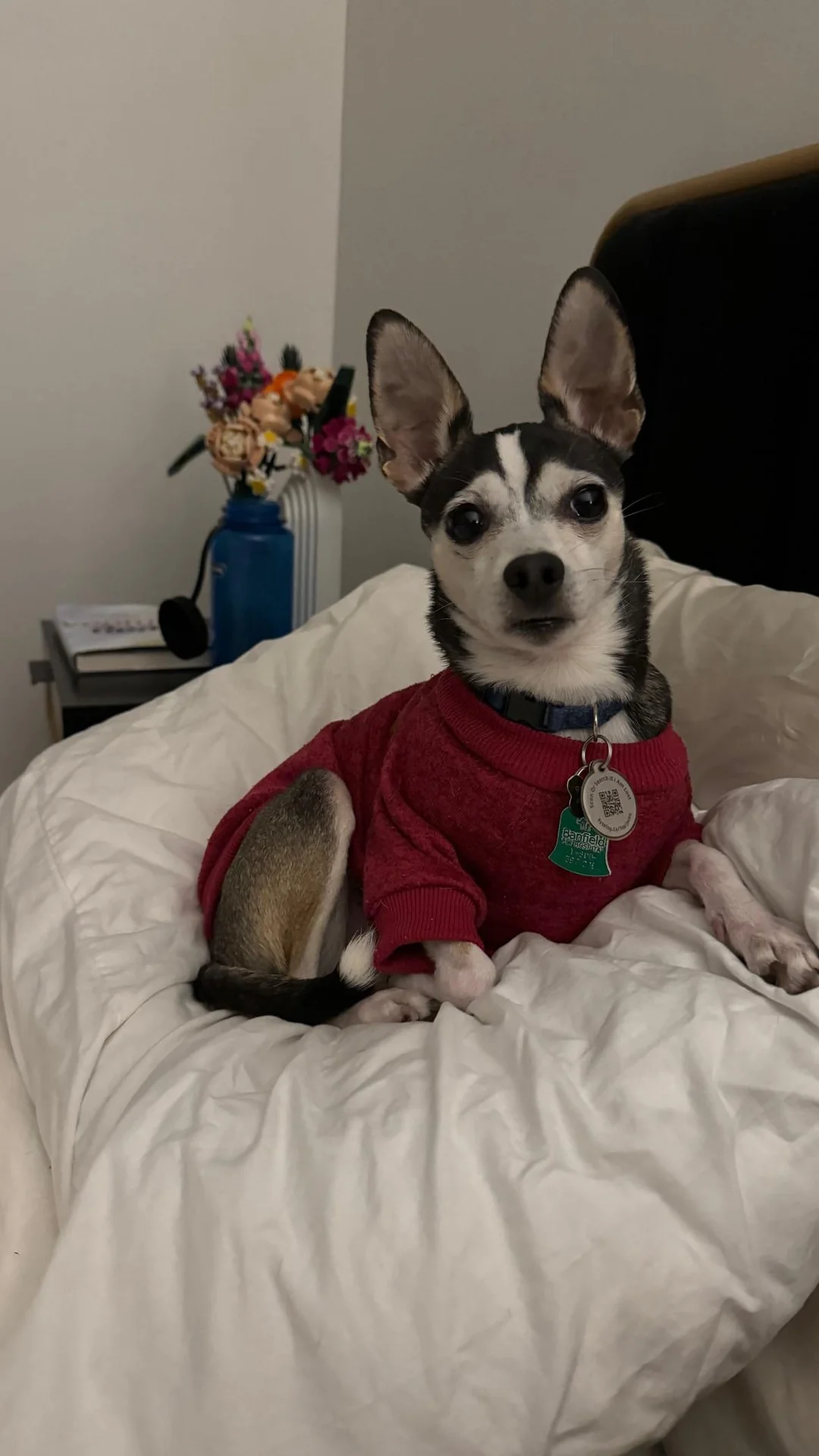
Your chihuahua comes home with a shaved patch, a plastic cone, a bag of pills, and a discharge sheet you will read four times before bed. Underneath all of it, post-operative care is three jobs: protect the incision, keep her comfortable, and enforce rest in a dog who will feel fine long before she is healed.
The chihuahua-specific part is scale: a small body sheds heat quickly, has little reserve when appetite dips, and takes medication in fractions of a dose. Your clinic's written instructions outrank anything general you read tonight, including this page.
Quick answer: Post-operative care is three jobs: protect the incision, keep her comfortable, and enforce rest in a dog who will feel fine long before she is healed. The chihuahua-specific part is scale, since a small body sheds heat quickly, has little reserve when appetite dips, and takes medication in fractions of a dose. The cone stays on until the sutures come out, commonly 7 to 14 days. A reduced appetite the first evening is expected; still refusing food at 24 hours is a call.
The first night home
Expect a groggy dog. Anesthetic drugs wear off over hours, and the VCA post-operative instructions for dogs describe drowsiness lasting roughly 24 hours, with behavior back to normal within 24 to 48. She may be wobbly, unusually quiet, or briefly whiny, and a mild cough from the breathing tube is common for a few days. Shivering and vocalizing during recovery are listed as normal in the AVMA's owner guide to anesthesia, worth knowing before it happens at nine at night.
Food comes back slowly: VCA suggests about half the usual dinner a few hours after surgery and the rest an hour later to reduce nausea, with water not restricted. Set her up in a quiet, draft-free room around 68 to 75°F. A shivering post-anesthetic chihuahua is not being theatrical; small dogs struggle to hold temperature, so a warm bed and a blanket she can burrow into are doing real work.
Reading the incision
Look at it twice a day in good light, and learn what normal looks like so the abnormal is obvious. According to the VCA guide to surgical incisions, a healthy incision is clean with its edges touching, and the surrounding skin is a normal or slightly reddish pink. A little blood may seep during the first 24 hours, especially after activity. Bruising is normal too, sometimes arriving days later and spreading well beyond the cut.
What is not normal: continuous dripping, seepage past 24 hours, growing swelling, angry redness, a foul smell, discharge, or an incision starting to open. That is a call, not a wait.
Two rules people break with good intentions. Never clean an incision with hydrogen peroxide or alcohol, which damage healing cells and hurt, and apply no cream or ointment unless your veterinarian told you to. No baths or swimming until the clinic clears it, because moisture carries bacteria into a wound. Sutures and staples usually come out 7 to 14 days after surgery, and the American College of Veterinary Surgeons is blunt that removal is a job for the veterinary team.
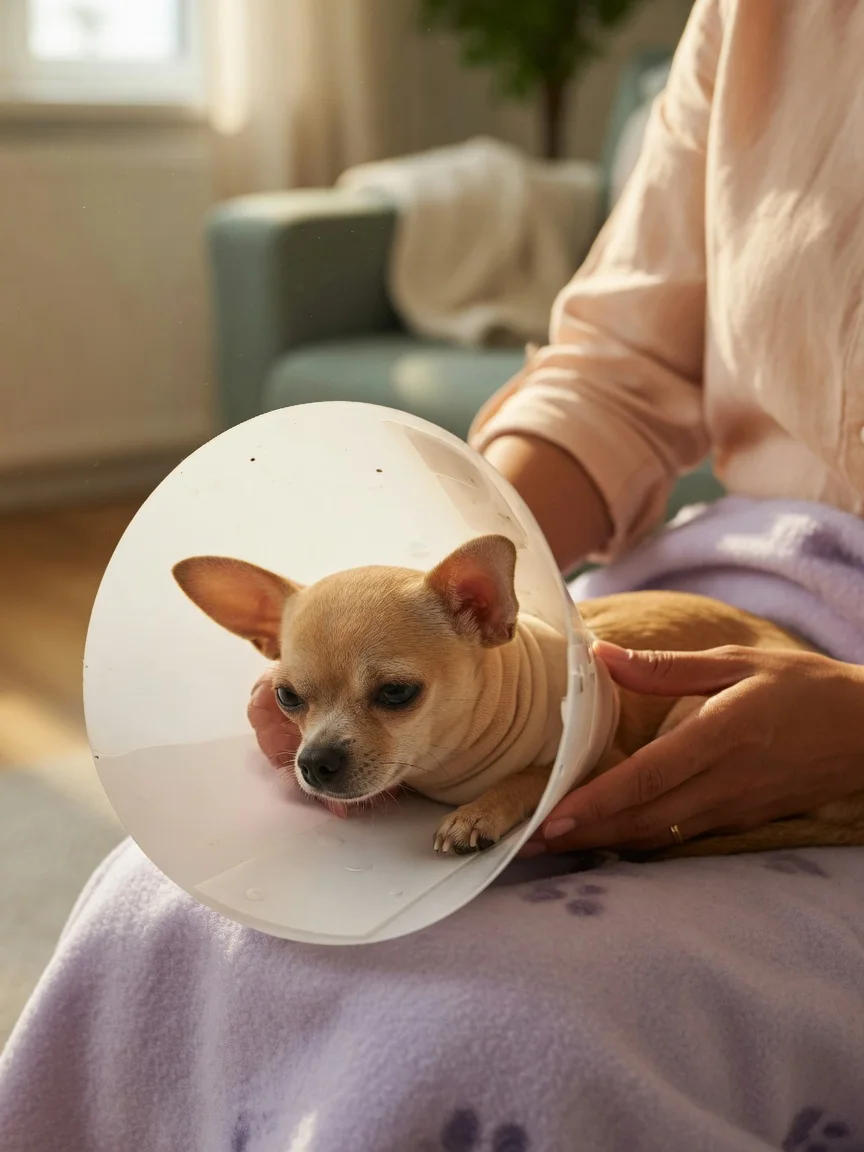
And the cone stays on. A recovery suit is a fine alternative when your clinic recommends one, but something must sit between tongue and stitches, because a few unsupervised seconds of licking can undo a week of healing.
Pain control, and the medicine you must never reach for
Give the prescribed pain relief exactly as written, including the doses that feel unnecessary because she seems comfortable. She seems comfortable partly because the medication is working, and ACVS notes that skipping doses increases discomfort and slows recovery.
Dogs hide pain in ways that look like nothing much: reluctance to move or settle, a hunched posture, reduced appetite, less interest in company, and a shorter fuse about being handled. In a chihuahua, a normally clingy dog who suddenly wants to be left alone is telling you something. Report what you see rather than adjusting anything yourself, and if pill-giving is the sticking point, our guide to medicating a small, opinionated dog covers the mechanics.
The absolute line: no human painkillers, ever, in any amount. Ibuprofen and acetaminophen are toxic to dogs and catastrophically so at chihuahua body weight, as covered in our guide to fever signs. If the prescribed medication does not seem to be holding her, call the clinic, which has safer options.
Enforcing rest in a dog who feels fine
Most procedures call for restricted activity for roughly 7 to 10 days, and orthopedic work such as patellar luxation repair often means weeks of confinement. Restricted means leashed trips outside for bathroom breaks only: no off-leash time, no stairs, no jumping onto the sofa.
The dangerous stretch is days three through five. She feels better, you relax, she launches off the bed after a squirrel, and you are back at the clinic. Set the environment so good behavior is the only option: a pen or small room, the sofa steps retired, slippery floors covered.
Confinement need not mean misery. Scatter-feed her ration on a towel, use a lick mat, and run gentle nose games that require no leaping, borrowing from our piece on keeping a chihuahua contented indoors. Mental work tires a dog properly and costs the incision nothing.
When to call your veterinarian
Emergency care now: an incision that has opened, uncontrolled bleeding, collapse, labored or noisy breathing, pale or gray gums, repeated vomiting, or a dog who cannot be roused. Same-day call: seepage past 24 hours, spreading redness or swelling, foul smell or discharge, no food or water 24 hours after coming home, no urination for 12 to 24 hours, pain that breaks through her medication, or a lost cone and a licked wound.
Routine appointment: the scheduled suture check, any lump under a healed incision, or a slow return to normal energy. Monitor at home: grogginess on night one, a mild cough for a few days, a modest appetite on day one, and bruising that appears without spreading.
Frequently asked questions
How long does my chihuahua have to wear the cone?
Generally until the sutures come out, commonly 7 to 14 days, with your clinic confirming the date. Taking it off early because she looks sad is how incisions reopen; if she truly cannot eat or drink in it, ask about a softer collar or a recovery suit.
My chihuahua will not eat after surgery. How long is that acceptable?
A reduced appetite on the first evening is expected as the anesthetic clears. If she is still refusing food 24 hours after coming home, or refusing water at any point, call the clinic, because a small dog has very little margin; our guide to appetite loss explains why that clock runs faster in this breed.
Is my chihuahua at greater risk under anesthesia because she is tiny?
Size brings specific challenges such as heat loss and precise dosing, but the AVMA notes that anesthesia-related deaths are rare and that risk tracks the pet's overall health and the procedure more closely than the anesthesia itself. Pre-anesthetic examination and bloodwork exist to find those risk factors first; our article on anesthesia and dental cleaning covers the conversation to have beforehand.
The clinic did the difficult part in an hour. Your part is duller and takes longer: a warm room, a cone that stays on, doses on time, a twice-daily look at the incision, and a week or two of frustrating a dog who wants her old life back. Put the clinic's after-hours number in your phone tonight, and treat any change you cannot explain as a reason to call rather than a reason to search.

No comments yet
Leave a comment