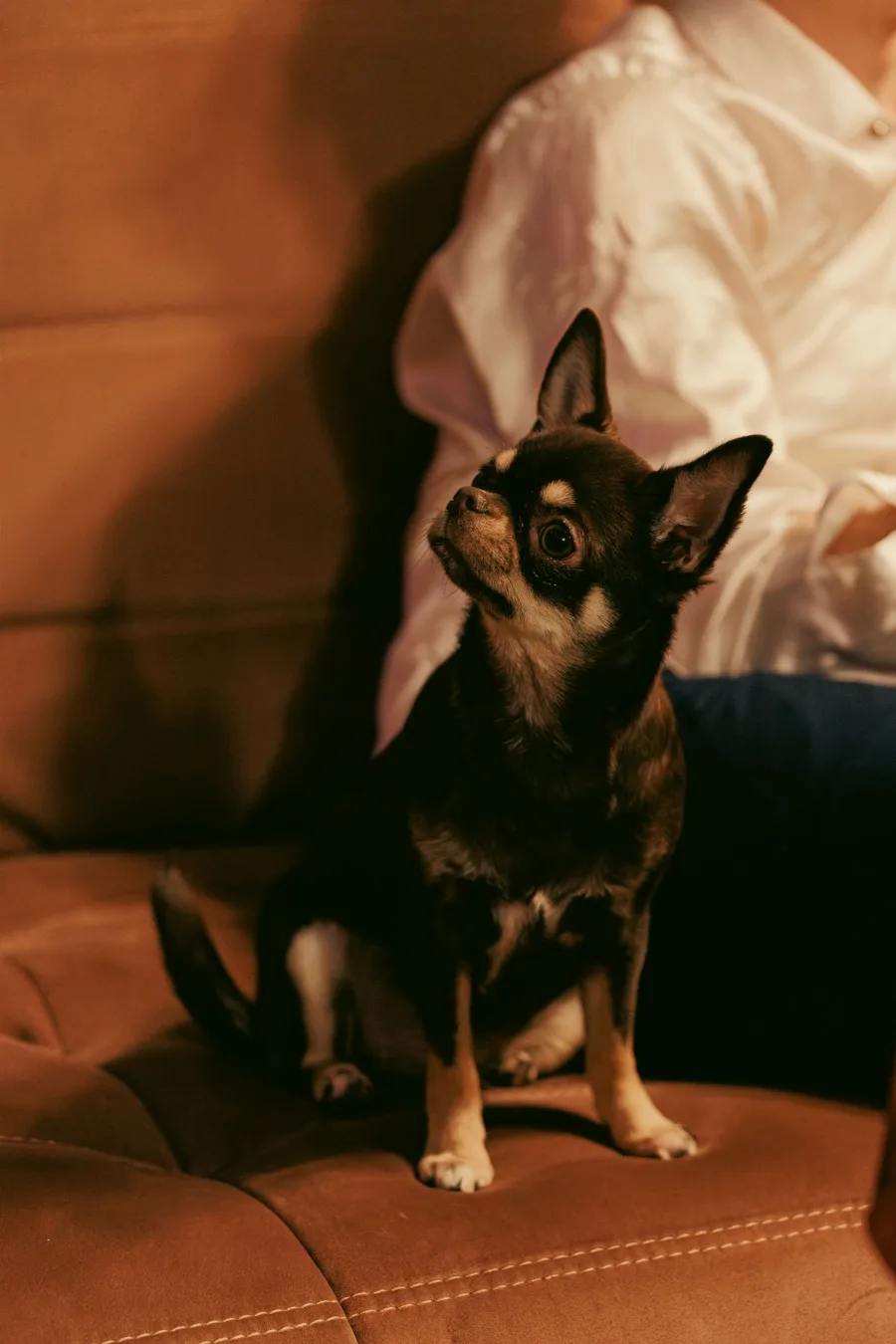
House rule five, added after an incident, is that I am not allowed to narrate a chihuahua's on-screen performance to the chihuahua sitting beside me. I have broken rule five roughly eleven times. Nacho has broken nothing, because in four years he has never once looked at the television, regardless of which of his relatives is on it.
This is inconvenient. The screen has been explaining chihuahuas to the general public since before I owned one, and the only primary source in my house weighs four pounds and declines to comment. So I ran the comparison myself, unpaid, from a brown couch, with the subject asleep against my leg.
The commercial that taught a country one Spanish phrase
Before the movies there was an advertisement. A chihuahua named Gidget fronted Taco Bell's campaign from 1997 to 2000, delivering "Yo quiero Taco Bell" in a voice supplied by the actor Carlos Alazraqui, and by 1998 you could not cross a school hallway without hearing a sixth grader attempt it. I was one of those sixth graders. I can still do the impression. It is not good. I do it anyway, and it remains my only contribution to advertising history.
The campaign is also a fair warning about what happens when a breed becomes a bit. Activists objected that the ads leaned on Hispanic stereotypes, according to ABC News reporting on Gidget's life and death; the ads ended in 2000, and Gidget died in July 2009 at fifteen. What outlived the campaign was a national assumption about how the dog sounds, which is about as reliable as the national assumption about how the word is pronounced.

October 2008, and the biggest week the breed ever had
Then Disney went large. Beverly Hills Chihuahua arrived on October 3, 2008, directed by Raja Gosnell, with Drew Barrymore voicing a pampered chihuahua named Chloe. Box Office Mojo lists a $29.3 million opening weekend across 3,215 theaters and a worldwide total of $149.3 million, which for one week made a four-pound dog the most commercially significant animal in the country.
The film's working theory is that a chihuahua's natural habitat is a monogrammed handbag on Rodeo Drive. I tested the general principle with a padded carrier that cost more than my first bicycle, a purchase our luxury desk would recognize immediately. Nacho enters the carrier under formal protest and sleeps, at home, by choice, in an empty laundry basket that came with the house. Disney had a $149 million idea. My dog had a free one.
What the box office did next
This part is not a joke, so I will keep it flat. A 2014 study in PLoS ONE by Stefano Ghirlanda, Alberto Acerbi and Harold Herzog found that dog movies were associated with rises in the featured breed's popularity for as long as a decade after release, with the size of the effect tracking how many people saw the film on its opening weekend. Popularity, though, is not the same thing as good outcomes.
On January 6, 2010, ABC News reported that fifteen chihuahuas flew from San Francisco Animal Care and Control to the ASPCA in New York on donated seats, because California had more of them than California wanted. The same report put chihuahuas at more than 30 percent of the state's shelter dog population.
Nobody has drawn a clean line from one movie ticket to one kennel, and no single cause explains a surplus that size. Our shelter-numbers file covers the fuller picture. The short version is that a screen can make a breed famous in a weekend, and famous is a poor reason to acquire an animal who will still be here in fifteen years.
Chacho, who has been fighting for a distributor since 2022
Which brings me to the film I have been waiting on for four years. On March 23, 2022, Netflix announced I, Chihuahua, directed by Jorge R. Gutiérrez, with Gabriel "Fluffy" Iglesias starring and producing. A chihuahua named Chacho pulls on a lucha libre mask, becomes Luchacho, and enters an international fighting tournament to defend his family's home.
It is not a Netflix film anymore. Deadline reported in February 2026 that Gutiérrez had revived the project with the UK company Snafu Pictures and launched it at the European Film Market, and reported in May 2026 that Iglesias, Diego Luna, Stephanie Beatriz and Ron Perlman would voice it, with Rocket Science taking world sales into the Cannes market. An underdog movie about an underdog dog has now spent four years being an underdog. I choose to read this as commitment to the theme.
I want it to land. I would also like the record to show that Nacho is unqualified for the tournament. He can reach a genuinely alarming speed, which our sprint desk puts in real numbers, but he can only hold it for about nine feet, after which he requires a blanket and a period of reflection. His complete combat history is one long-running dispute with the toaster, which he has never won and never conceded, and which is the entire evidentiary basis for the reputation the breed cannot shake. Our ankle-biter myth piece handles the rest.
Rule five stands, in theory. In practice I will put the movie on the day it exists, and I will narrate it, and the four-pound consultant will sleep through the whole thing on the same brown couch where he has slept through every chihuahua ever broadcast. That is the finding of thirty years of casting.
The screen keeps writing the part, and the dog keeps declining it. He is not a catchphrase, a handbag accessory, or a masked contender with a tournament bracket. He is one specific small animal, bred over centuries to decide that my leg is warm, and no studio has ever offered me a cent for him. The most-watched chihuahua performance of the era had a name of its own: Moonie, who played Bruiser in both Legally Blonde films and lived to eighteen. The campaign's actual star is worth knowing properly: Gidget was female, played a male character, and outlived the ads by nine years.



No comments yet
Leave a comment