Charles Cruft's first show under his own name opened at the Royal Agricultural Hall in Islington in 1891 with 2,437 entries across 36 breeds, according to the show's published history. Best in Show did not exist until 1928. Guinness World Records later certified it as the largest dog show on record, on 22,993 entries in January 1991. Chihuahuas turn up at the modern version twice, on two separate entry lines, and explaining why is the quickest route into how the breed competes.
Quick answer: The Kennel Club lists Chihuahua (Smooth Coat) and Chihuahua (Long Coat) as separate breeds within the Toy Group, each with its own standard, its own Challenge Certificates, and its own Best of Breed at Crufts, so the two coats never compete against each other. Crufts is qualification-only: a dog must earn its place during the previous year's qualifying window. No chihuahua of either coat has won Best in Show since the award began in 1928.
Two breeds on the entry form, one breed in the whelping box
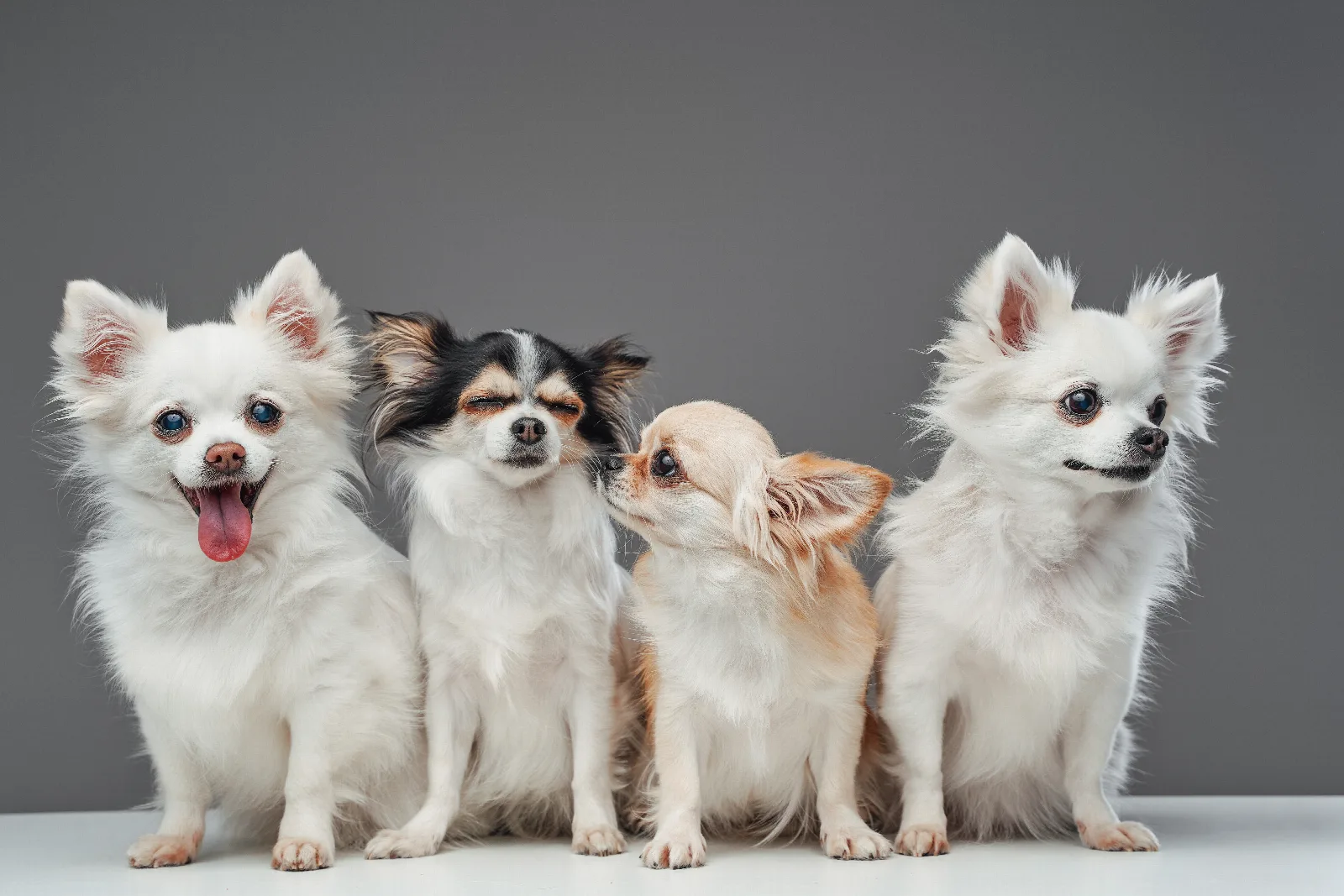
The Kennel Club lists Chihuahua (Smooth Coat) and Chihuahua (Long Coat) as separate breeds within the Toy Group. Each has its own breed standard, its own set of Challenge Certificates, and its own Best of Breed at Crufts. A smooth coat never competes against a long coat in the breed ring. They meet, if at all, in the Toy Group line-up.
The genetics did not read the paperwork. Two smooth-coated parents can produce a long-coated puppy, and on 5 June 2020 the Kennel Club Board agreed to allow inter-variety matings of Smooth and Long Coat chihuahuas without prior permission, on genetic diversity grounds. Note the club's own wording there: inter-variety, not inter-breed. Two breeds administratively, one breed biologically, which is roughly how the recognized coat varieties behave everywhere else. Owning a long coat is not owning a rarer animal, only a differently filed one.
Crufts is a qualification-only show
You cannot simply enter. Dogs must earn a place during a qualifying window running roughly from one January to the next, and the published qualification routes are specific. A dog qualifies if it holds a title such as Champion, Show Champion, Obedience Champion or Agility Champion; if it has a Kennel Club Stud Book Number, which qualifies it for life; if it placed first, second or third in a designated class, from Minor Puppy to Veteran, at a championship show where Challenge Certificates were on offer; if it won a first prize in any breed class at the previous year's Crufts; or through placings at Premier Open Shows and top wins at general and group Open Shows.
So every chihuahua at Crufts has already had a competitive season behind it. The show is a final, not an open trial, which is worth knowing before you read a beginner's guide to dog showing and assume Birmingham is step one.
What the judge is assessing
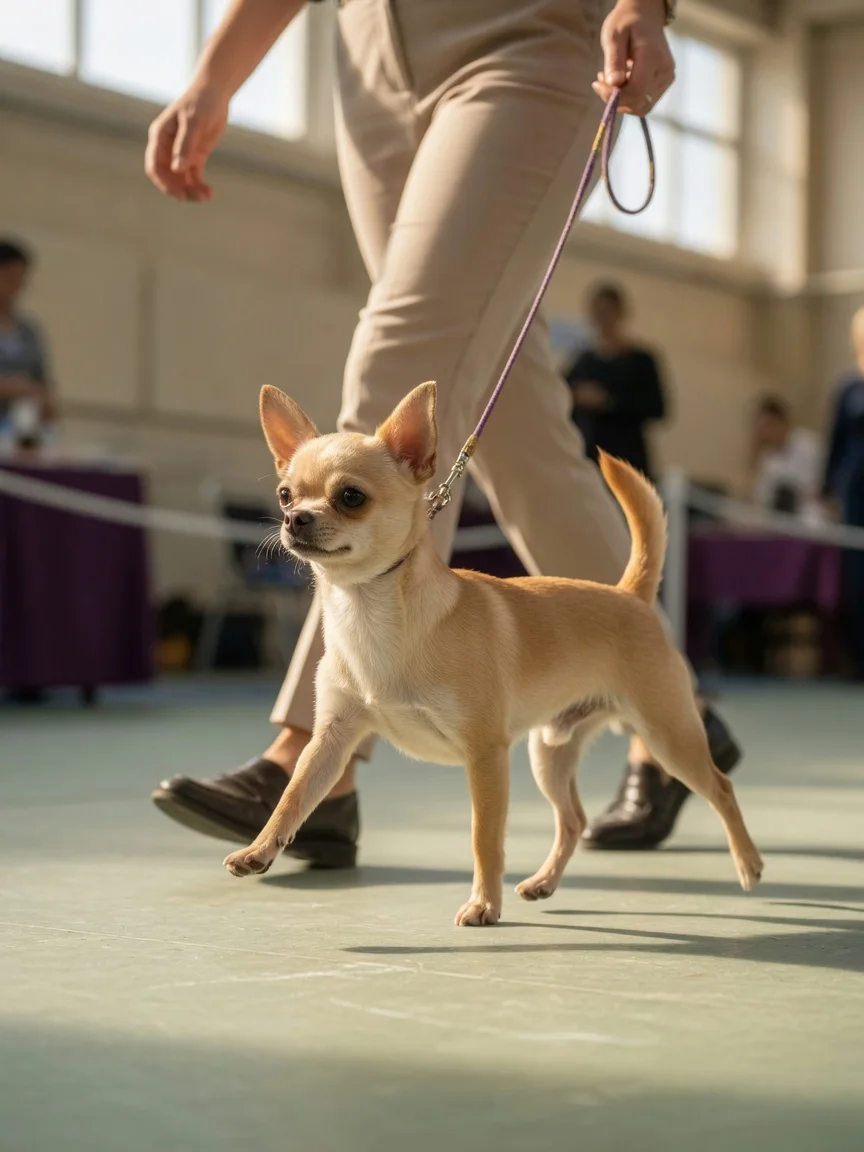
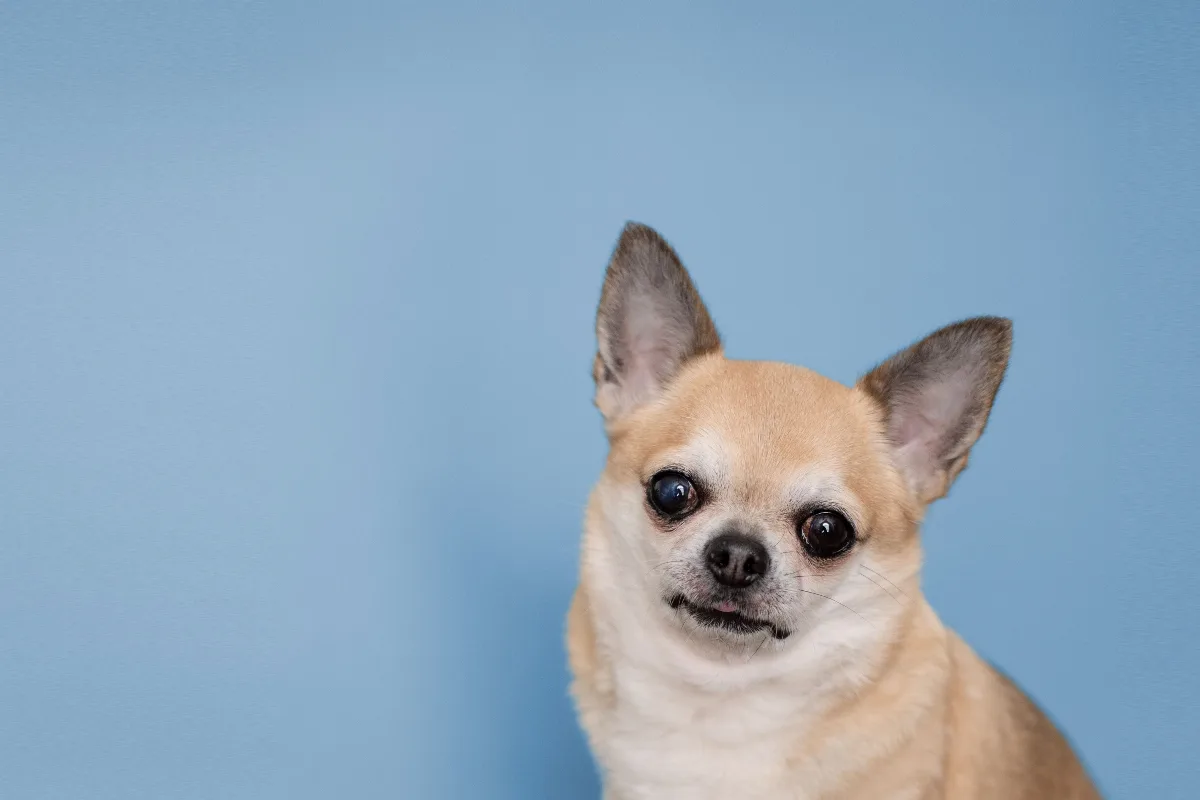
The Kennel Club standard opens with three words: "Small, dainty, compact." It asks for a well-rounded "apple dome" skull, lean cheeks and jaws, a moderately short and slightly pointed muzzle, and large flaring ears set at roughly 45 degrees. Movement should be "brisk, forceful action, neither high-stepping nor hackney." The apple head and deer head labels never appear as categories. Only the first shape is described, and the second is a term owners use, not a box a judge ticks.
The weight clause deserves a moment. The standard permits up to 2.7 kg (6 lb) and states that 1.8 to 2.7 kg, or 4 to 6 lb, is preferred. Read the direction of that preference: the show ring wants the upper half of the range. Nothing in it rewards a two-pound dog, which is worth remembering the next time "teacup" appears attached to a price, and it matches the breed's healthy adult size range.
Both coat breeds sit in Breed Watch Category 2, meaning judges are asked to watch for and report specific points of concern: incorrect bite, incorrect dentition, retained puppy teeth, misplaced or missing teeth, wry jaw, and an excessively short muzzle. Three of the six are teeth, which will surprise nobody who has spent time with a toy breed's dental care.
The rings that are not the breed ring
Conformation is one afternoon of a four-day event. Crufts also runs agility, obedience, flyball and heelwork to music, and the size categories have recently improved for very small dogs. Agility's Small class covers dogs measuring 350 mm and under at the withers, and in 2025 the Kennel Club added an Extra Small height under Annex F of the agility regulations, with obstacles scaled to match. Agility qualification runs through heats at licensed shows between 1 March and 31 October.
Rescue Dog Agility joined the programme in 2000, and Scruffts runs classes for crossbreeds. None of that requires a pedigree, a Stud Book Number, or a skull the standard approves of, which is the more useful news for most owners reading this.
The Best in Show ceiling
No chihuahua has ever won Best in Show at Crufts. The award has been given since 1928, when a greyhound named Primley Sceptre took the first one, and the roll of winners contains very few toy breeds at all: a Cavalier King Charles Spaniel in 1973, a Toy Poodle in 1982, a Yorkshire Terrier in 1997, a Papillon in 2019. Chihuahuas take Best of Breed every year and place in Toy Group judging, and that is where the run has stopped.
Why is a fair question without a settled answer. Group and Best in Show judging rewards outline, presence and ground-covering movement across a large ring, and a six-pound dog with a short stride is working against the optics rather than the standard. That is an observation about how big rings read, not a verdict on the breed. It has been 98 years, though.
Frequently asked questions
Can any chihuahua be entered at Crufts?
No. Crufts is qualification-only, and a dog must earn its place during the previous year's qualifying window through championship show placings, a title, a Stud Book Number, or another published route. Kennel Club registration alone is not enough.
Why are smooth and long coat chihuahuas judged separately?
Because the Kennel Club lists them as separate breeds with separate standards and separate Challenge Certificates, so each takes its own Best of Breed. The split is administrative rather than genetic: the two coats interbreed freely, and since June 2020 the Kennel Club has permitted inter-variety matings without prior approval.
Has a chihuahua ever won Best in Show at Crufts?
Not since the award began in 1928. Chihuahuas regularly win Best of Breed and appear in Toy Group judging, but no chihuahua of either coat appears in the Crufts Best in Show hall of fame.
Can a chihuahua realistically compete in agility?
Yes, and the classes now fit better than they used to. Kennel Club agility runs a Small height for dogs measuring 350 mm and under, and added an Extra Small height in 2025 with scaled obstacles. Talk to your vet first if your dog has knee, trachea or heart concerns, since jumping and tight turns do not suit every individual.
A chihuahua at Crufts competes inside a system built long before the breed became popular, judged against a standard that quietly prefers the sturdier end of it, and split across two entry lines for historical rather than biological reasons. Best in Show remains unclaimed. Best of Breed, group placings and agility rosettes are all thoroughly available, and the dog will have no idea which was supposed to matter most.


No comments yet
Leave a comment