
The scene reports itself with remarkable consistency: the relationship is going wonderfully, except that four pounds of chaperone now sits between you on the couch, stares down every hug, and growls when your partner approaches the bed. Chihuahua jealousy is real enough to have a plan for, and the plan works, but it starts with a translation, because what the dog is doing is not romance-novel jealousy. It is a mix of resource guarding, where the resource is you, and plain disrupted routine, and both of those are trainable.
Quick answer: What looks like jealousy is usually resource guarding, where the resource is you, plus a plainly disrupted routine. The fix is a provider switch: have your partner run the meals, the walks, and the games, and train invitation-based couch and bed access with a defined spot of her own. Most dogs thaw visibly within a few weeks and genuinely convert within a couple of months. Polite indifference is a perfectly acceptable end state for a strongly one-person chihuahua.
What is actually happening
Chihuahuas bond hard, often to one person, the pattern our velcro guide describes, and to a strongly bonded dog you are the warm spot, the food source, the safety signal, and the entire social calendar in one body. A new partner rearranges access to all of it at once: couch geography, bed geography, attention schedules, even household smells and sounds. Some dogs shrug; a committed chihuahua files an objection.
The objection takes two forms: displacement behaviors, wedging between you, pawing, barking during hugs, sudden dramatic needs the moment affection starts, and guarding proper, stiffening, staring, growling, or snapping when the partner approaches you, the couch, or the bed. Behavior research has shown dogs displaying jealousy-like responses when their person attends to a rival, so the owners saying she is jealous are not imagining it; the working translation for training purposes is guarding-plus-disruption, the territory of the ASPCA's aggression resources.
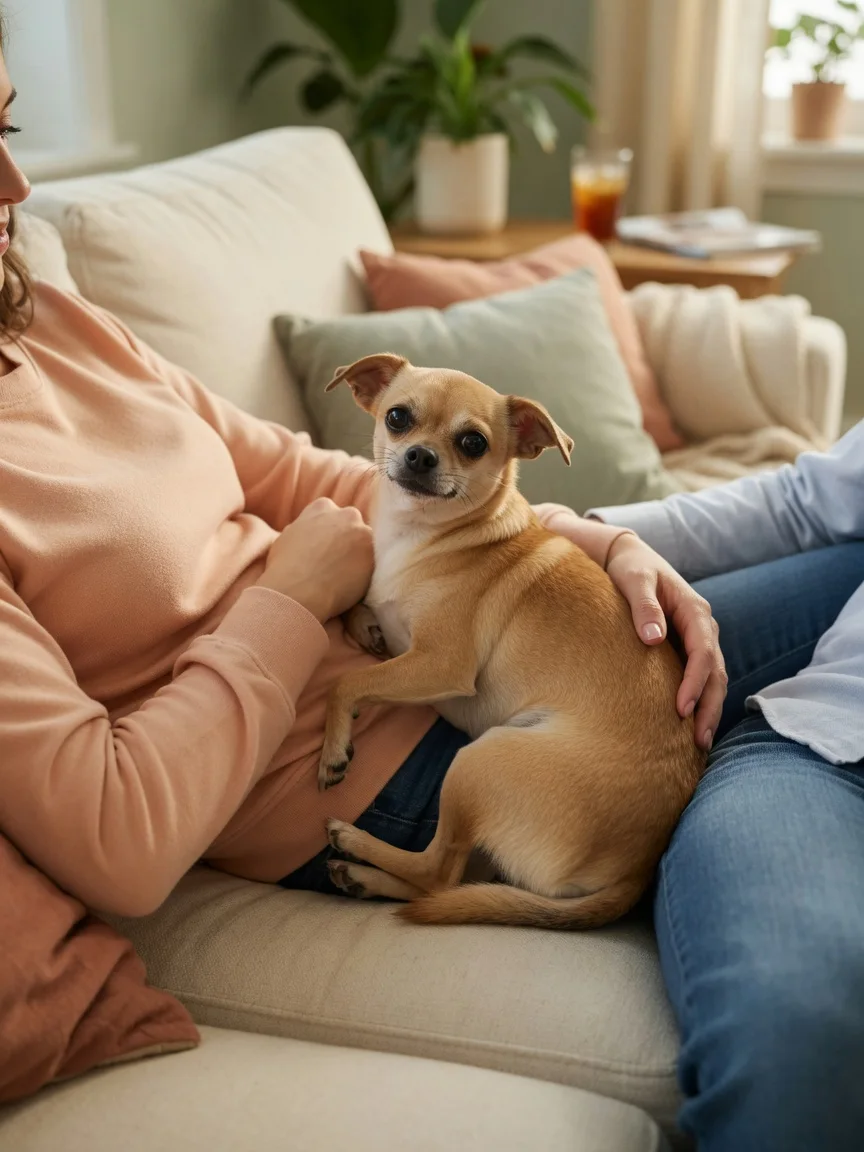
The plan: partner becomes provider
Rewire who the good things come from. This is the engine of the whole fix. For the coming weeks, your partner delivers the paychecks: meals, treats, the evening walk, the flirt-pole game, the bedtime chew. You, the guarded resource, go pleasantly neutral. The math the dog runs is ancient and reliable: the person who predicts dinner and adventures is hard to classify as an enemy. Expect visible progress in weeks, not days, and let the dog set the pace of warming up; forced cuddles from the new provider reset the clock.
Make affection between humans predict good things for the dog. Hug, and a treat lands on her mat. Sit close on the couch, treat on the mat. Repeated, the rival-alert moments become cheese forecasts, which is counterconditioning doing its quiet work on the emotion underneath the drama.
Install couch and bed protocol. Furniture access becomes invitation-based: a trained up cue, a cheerful paid off cue, and a defined spot of her own, the blanket-based assigned seat from our bed-sharing guide. The bonded person teaches the cues first, since compliance starts where the attachment lives, then the partner runs them with premium pay. During the training weeks, if bed growling is on the menu, the dog sleeps in her own excellent bed beside you, not as punishment but as management: rehearsed guarding is strengthened guarding.
Honor the growl, fix the cause. The rule from our biting guide applies with force here: never punish the growl, because silencing the warning system while the emotion remains is how no-warning snaps are built. A growl means back up one step in the plan, widen distances, raise pay, and proceed more gradually. Punishment from either human, especially the partner, confirms the dog's whole thesis.
Keep her world funded. Jealousy shrinks when the dog's own economy is rich: walks, food puzzles, training games, and one-on-one time with her original person that does not depend on the partner's absence. A bored velcro dog guards the only asset she has; a busy one has a portfolio.
Special cases
The couch snap that connects, or guarding that extends to food and toys, moves this from home plan to professional plan: ask your veterinarian for a referral to a reward-based trainer or behavior specialist, and manage access to the guarded zones meanwhile.
A new baby on the horizon runs on this same architecture, started months early: baby sounds, gear, and routines paired with good things, furniture protocol installed in advance, and never an unsupervised moment between any dog and any infant. And sudden possessiveness in a previously easygoing dog earns the usual medical check first; pain and illness routinely debut as clinginess and irritability, per our watch-for guide.
When to call your veterinarian
Same-day call: sudden-onset possessiveness or irritability with any appetite, energy, or mobility change. Ask for a referral: snaps that connect, growling that escalates across weeks despite the plan, or guarding spreading to new contexts. Training territory: the wedging, the theatrical sighs, the couch chaperoning, and the early-stage growl, all of which the provider-switch plan above resolves in most households within a month or two of consistency, per the humane framework in the AVSAB position statements.
Frequently asked questions
Why does my chihuahua growl at my partner in bed?
She is guarding the household's most valuable territory, the sleeping spot beside you. Run the provider switch, train invitation-based bed access with a defined spot of her own, and manage with her own bedside bed while the growling untrains. Punishing the growl is the one reliably wrong move.
Do dogs really feel jealousy?
Research has observed jealousy-like behavior in dogs when their person attends to a rival, so something real is happening. For fixing it, the useful translation is resource guarding plus disrupted routine, both of which respond to the counterconditioning plan above regardless of what we call the feeling.
How long until my chihuahua accepts my partner?
With the partner running meals, walks, and games, most dogs thaw visibly inside a few weeks and genuinely convert within a couple of months. The timeline stretches when the guarding is rehearsed daily, which is what the management pieces, assigned spots and invitation access, exist to prevent.
My chihuahua ignores my partner completely. Is that a problem?
No, polite indifference is a perfectly acceptable end state, and for many one-person chihuahuas it is the honest ceiling. The plan's goal is a dog who is relaxed and safe around the partner; adoration is a bonus, and it frequently arrives around month three, carried in on the smell of the dinner they now serve.
Jealousy is a chihuahua defending the best thing she owns with the tools she has. Change the economics so the newcomer funds her world, keep every warning legal, assign the real estate, and the chaperone stands down, usually into the newly discovered second-favorite lap in the house.

No comments yet
Leave a comment