MacKenzie, a four-pound chihuahua born with a cleft palate, was named the 2020 American Hero Dog, the top national honor at American Humane's annual Hero Dog Awards. The winner was revealed during the program's 10th anniversary broadcast on the Hallmark Channel on October 19, 2020, and American Humane confirmed the result in a Los Angeles announcement the following day.
MacKenzie lived in Hilton, New York, and worked at The Mia Foundation, a Rochester-area nonprofit that takes in animals born with birth defects. She died on March 15, 2023, at the age of 9, which makes this a retrospective rather than a current story.
Quick answer: MacKenzie, a four-pound chihuahua born with a cleft palate, was named the 2020 American Hero Dog, American Humane's top national honour, revealed on the Hallmark Channel on October 19, 2020. She lived in Hilton, New York and worked at The Mia Foundation, a Rochester-area nonprofit taking in animals born with birth defects. She died on March 15, 2023, aged 9. A cleft palate can occur in any breed and is predominantly inherited.
What the 2020 award recognized
The Hero Dog Awards run in seven categories, and MacKenzie entered as a shelter dog. Spectrum News Rochester reported on August 6, 2020 that she had taken the Hero Shelter Dog of the Year title, making her one of seven finalists booked for the two-hour Hallmark broadcast that fall. The national prize came in October. According to American Humane's announcement, MacKenzie finished ahead of 407 other entrants, with the outcome decided by more than one million public votes combined with a panel of celebrity judges.
The other 2020 category winners were Olive, a therapy dog from Jefferson City, Missouri; Dolly Pawton, a service dog from Naples, Maine; Blue II P491, a military dog from Lawrenceville, Georgia; Aura, a guide and hearing dog from Brunswick, Maine; K-9 Cody, a law enforcement dog from Newport News, Virginia; and Remington, a search and rescue dog from Montgomery, Texas.
Dr. Robin Ganzert, president and chief executive of American Humane, described the finalists in that announcement as dogs that had served on battlefields and beside the ill and the aging. MacKenzie's record was unlike any of theirs. Her work was with other animals, and she reached the ballot through the shelter category, which is the entry point for a breed that turns up in American shelters in disproportionate numbers.
A cleft palate at chihuahua scale
A cleft palate is a gap in the roof of the mouth caused by a defect in how the jaw and face form before birth, according to the Merck Veterinary Manual. Newborns with the defect struggle to nurse, milk can come back out through the nostrils, and regurgitated food can enter the lungs and cause severe, repeated pneumonia.
Merck states that affected puppies need intensive care including hand or tube feeding, that surgical correction is generally most successful once a puppy is at least 12 weeks old, and that the defect is predominantly inherited, which is why affected animals are advised to be spayed or neutered. None of that is specific to this breed, though it lands in the same category of congenital detail as the molera and belongs in any conversation about chihuahua whelping.
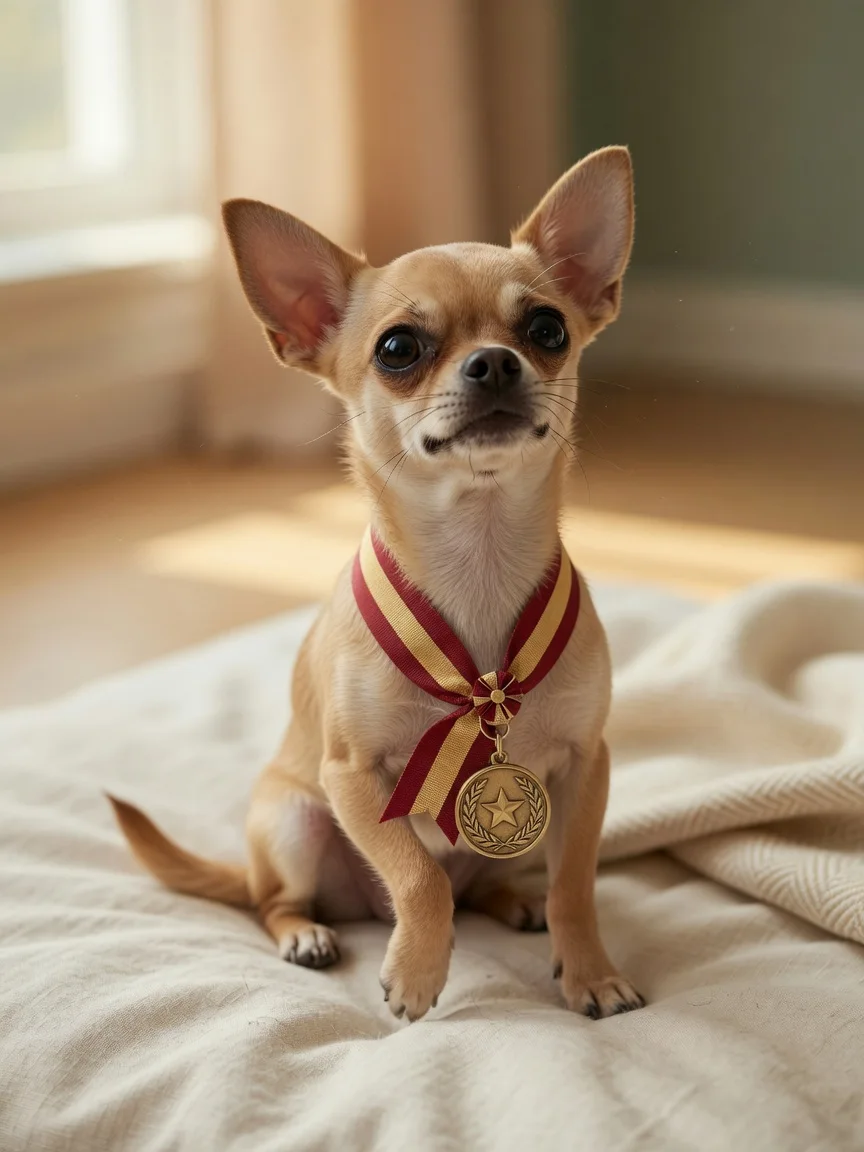
MacKenzie's own course followed that pattern closely. Sue Rogers, who runs The Mia Foundation, took her at one day old and bottle-fed her, Spectrum News reported. News coverage published at the time of her win reported that she was tube-fed for close to a year before surgery let her eat and drink on her own, and that she survived several bouts of aspiration pneumonia. She never got a normal bark back. At four pounds she stayed at the lower end of a breed whose standard tops out around six.
The job at The Mia Foundation
The foundation is named for Mia, an earlier cleft palate chihuahua whose name its Facebook page still carries, and it takes in animals born with birth defects, many of them newborns separated from their mothers for medical reasons. MacKenzie's role was to sit with them. Accounts published at the time of her win reported that she had mothered puppies, kittens, a goat, a turkey, a squirrel, birds, a mouse and a Great Dane. Rogers told Spectrum News Rochester that even with her own health problems, "she was always more concerned about the other dogs."
She also worked off site. MacKenzie visited schoolchildren as part of the foundation's outreach on accepting physical differences, according to coverage of her award. That is closer to therapy visiting than to the trained assistance work covered by service dog law, and the Hero Dog Awards keep those categories separate for exactly that reason.
What happened after 2020
MacKenzie died on March 15, 2023, at 9 years old, The Mia Foundation announced on its official Facebook page. The post did not state a cause of death. Rogers wrote that MacKenzie had been central to the organization, and that the loss, coming after the death of another of her dogs in December 2022, had made her question whether to continue in rescue at all. She said she would keep helping animals born with birth defects, through education and through financial support to qualified rescues.
Two things remain unclear in the public record. No cause of death has been published, and the coverage reviewed here does not give MacKenzie's exact birth date, only that she was about seven at the time of the award and nine when she died. Neither gap changes the verified part of the story, and both are worth stating plainly rather than filling in.
Frequently asked questions
Which dog won the 2020 American Humane Hero Dog Awards?
MacKenzie, a four-pound chihuahua from Hilton, New York, born with a cleft palate. She won the Hero Shelter Dog of the Year category first, then the overall American Hero Dog title, which American Humane announced on October 20, 2020, the day after the ceremony aired on the Hallmark Channel.
Is MacKenzie the chihuahua still alive?
No. The Mia Foundation announced on its Facebook page that MacKenzie died on March 15, 2023, at the age of 9. The organization did not publish a cause of death, and said it would continue supporting animals born with birth defects through education and grants to other rescues.
Can chihuahuas be born with a cleft palate?
Yes. A cleft palate can occur in any breed, and the Merck Veterinary Manual describes it as predominantly inherited. Affected puppies usually cannot nurse normally and are at risk of aspiration pneumonia, so a newborn with milk coming from the nose or obvious trouble suckling needs a veterinary examination the same day.
The useful part of the record is small and specific, which is the most an award story can honestly claim. A dog who could not eat on her own for the first year of her life spent the next eight years sitting with newborn animals that could not eat on their own either, and in October 2020 more than a million voters decided that counted. She is still listed as American Humane's 2020 winner. The condition she was born with is still the reason a breeder or a new owner should get a newborn examined the first time milk comes out the wrong way.


No comments yet
Leave a comment