My chihuahua Nacho has a recall command. He has had it for four years. It works reliably in the kitchen, intermittently in the hallway, and nowhere else on the surface of the earth. Our guide to basic cues is very good on this and I have read it twice. I mention all of it because on a Sunday morning in April 2016, a chihuahua in San Francisco demonstrated the far end of the same problem, and resolving it took the California Highway Patrol, a motorcycle, a patrol car, several roadblocks, and one officer's jacket.
Quick answer: Just after 7 a.m. on Sunday, April 3, 2016, a driver called the California Highway Patrol to report a dog loose on the Bay Bridge. Officers found a chihuahua on the north side catwalk of the westbound span and eventually recovered him. It is the best-documented version of a scenario every owner of the breed recognises in miniature: a small dog, a startled bolt, and a recall command that works reliably in the kitchen and nowhere else.
What happened on April 3, 2016
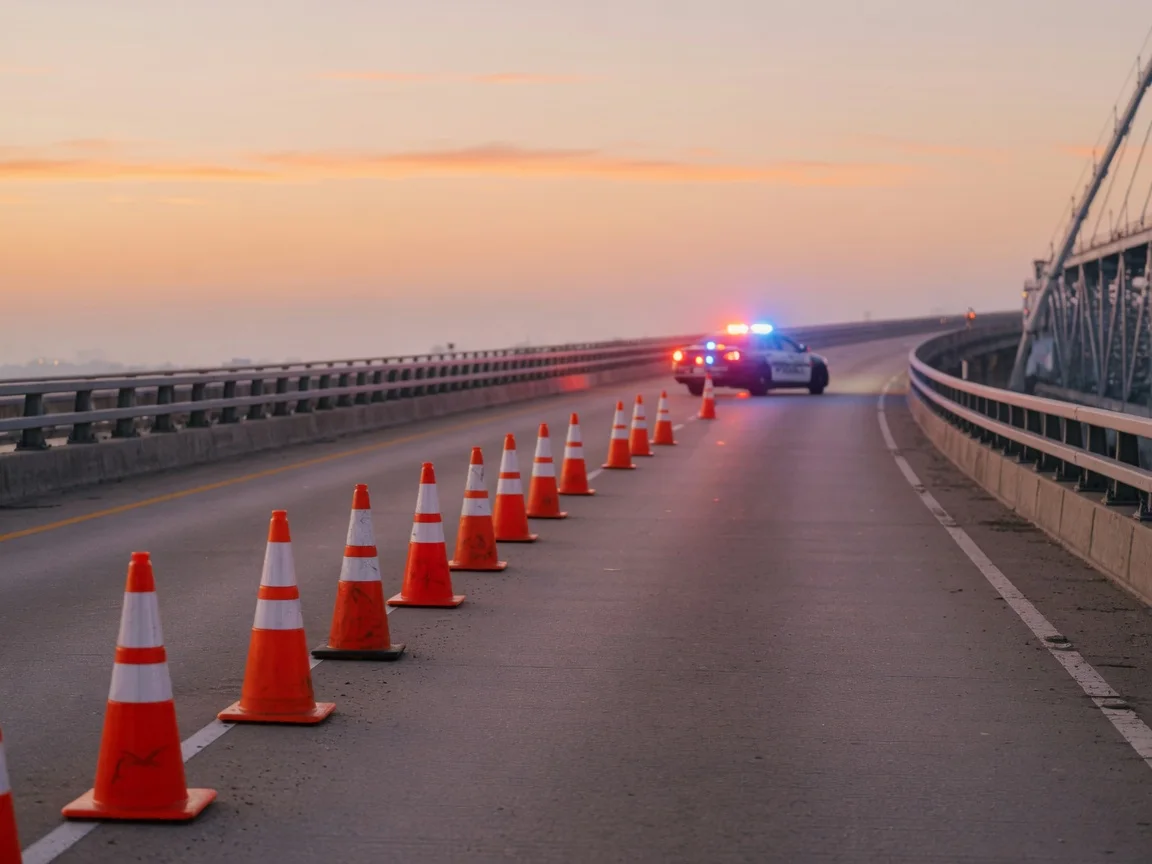
Just after 7 a.m. on Sunday, April 3, 2016, a driver called the CHP to report a dog loose on the Bay Bridge, according to NBC Bay Area. Officers spotted him on the north side catwalk of the westbound span, moving toward San Francisco. An officer stopped traffic so that nobody would hit him. A motorcycle officer approached to pick him up.
The dog declined.
Consider the inventory on that bridge at seven in the morning: steel, concrete, a mid-century engineering achievement, a suspended commute, a police motorcycle, and ten pounds of dog who had been briefed on none of it. ABC7 News put his weight at ten pounds. For the next several minutes, the bridge belonged to him.
Five minutes and a jacket
Officers set up roadblocks. He ran around them, which is the detail that separates a chihuahua from a problem roadblocks can solve. Eventually a motorcycle officer and a patrol car boxed him in. CHP Officer Vu Williams described the finish to ABC7 News: "I used my jacket to distract him and the motor officer came up and took him into custody." The foot chase lasted roughly five minutes, per NBC Bay Area.
Five minutes sounds brief. It is not. Our file on chihuahua top speed explains why a small dog covers ground wildly out of proportion to its parts, and anyone who has tried to collect one from under a parked car already knows the applied version. I once spent eleven minutes extracting Nacho from beneath a neighbor's Corolla. There was no bridge, no bay, and no traffic, and I lost the first nine of those minutes to strategy.
He was booked as Ponch
The dog was taken to San Francisco Animal Care and Control, where staff gave him a temporary name: Ponch, after Erik Estrada's character on the 1970s series CHiPs. Somebody in that building made that decision on purpose, and I would like them to know it was the correct one.
He was black, male, and roughly four years old, wearing a collar with a small skull charm and no identification whatsoever, CBS San Francisco reported. He had no microchip either. I have thought about that collar more than is reasonable, mainly because I checked Nacho's tag twice while writing this paragraph and then went and checked it a third time. Our comparison of collars and harnesses handles the gear question properly. The part that mattered on this particular morning was cheap, boring, and engraved.
What was never explained
Nobody established how he got onto the bridge in the first place. Officer Williams told CBS San Francisco: "We don't think he was thrown from a vehicle. He didn't look injured." Officers raised the possibility that he had come from Treasure Island, or slipped out of a car stopped on the span. Neither was ever confirmed, and no owner came forward. Our piece on why chihuahuas bolt covers the ordinary versions of this, none of which finish on a bridge deck. The honest summary of this one is that the first chapter is still missing.
Twenty-five days later
Deb Campbell, a spokeswoman for San Francisco Animal Care and Control, told SFist that the dog was "slowly coming out of his shell," and told CBS San Francisco that "although apparently still shaken up from Sunday's incident, Ponch seems to be in good condition." He went into foster care.
When the shelter listed him for adoption in mid-April 2016, the notice asked for "a gentle, mellow, adults-only home" and an adopter with previous experience with "small/shy dogs." That is close to what our confidence-building guide and our rescue adoption advice would recommend for any dog who had recently had the worst morning of his life.
On Thursday, April 28, 2016, ABC7 News reported that Ponch went home with a family who asked to remain anonymous. Twenty-five days, bridge to sofa. They gave no interview, which I respect and also find mildly disappointing, in that order.
The version of this that traveled online was a small dog outrunning the highway patrol, and I understand the appeal, because there is something genuinely funny about several trained officers failing to corner an animal the size of a lunch bag. The version I keep is duller and better. A frightened four-year-old stray with a skull on his collar and no phone number on it was picked up before anything happened to him, held for twenty-five days, and driven home by people who did not want the credit.
Nacho's recall still expires at the end of the hallway, and we have settled the matter with a tag, a microchip, a doubled leash, and a standing household rule that nobody opens the front door while holding groceries. I describe this to visitors as discipline. It is closer to the truth to say that I have read this story once and would rather not read a version with his name in it.


No comments yet
Leave a comment