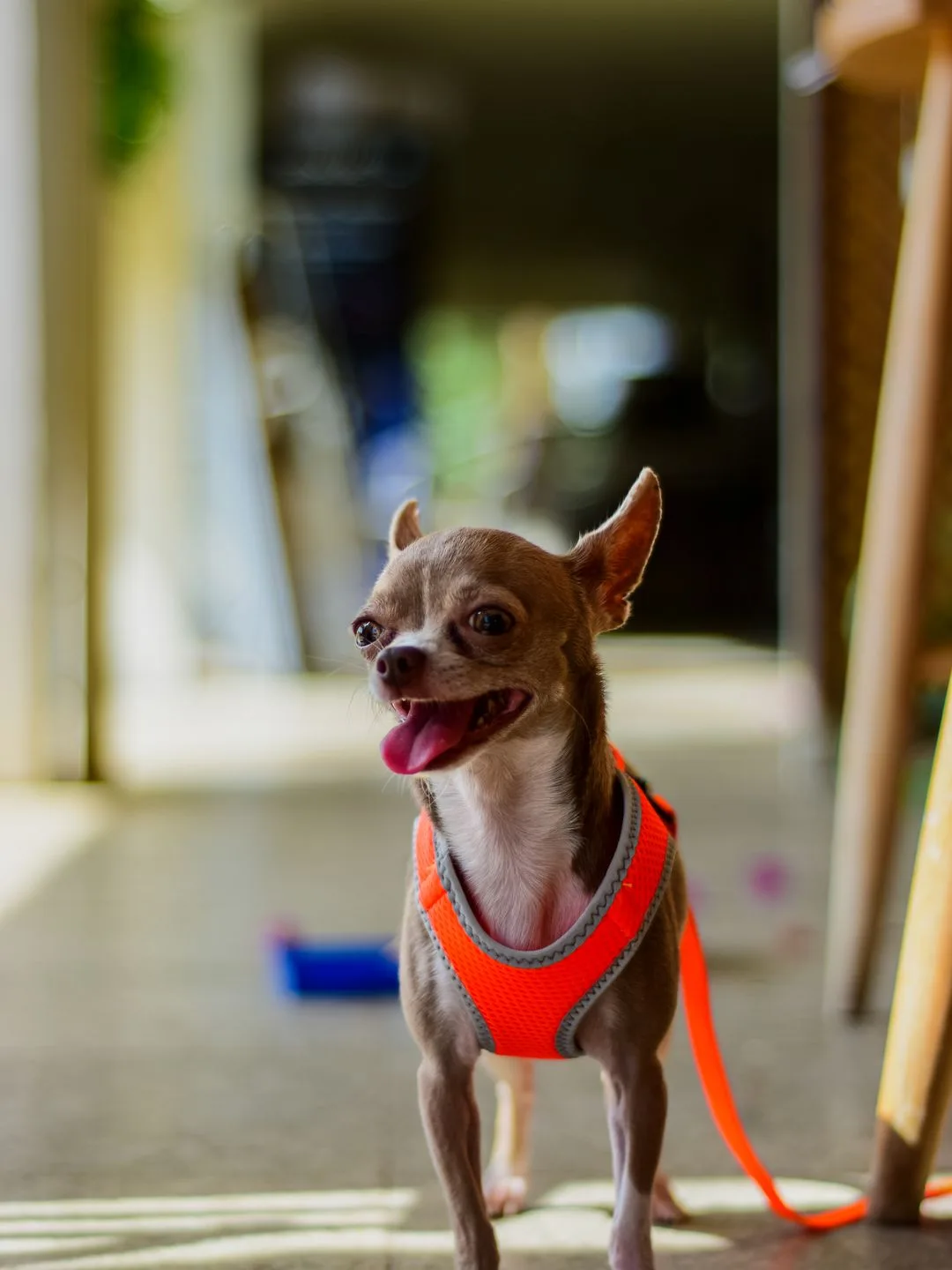
Most dog-gear debates end in it depends. This one does not. For a chihuahua, the leash clips to a harness, the ID tag hangs on a collar, and both live on the same dog doing different jobs. The reasoning fits in one anatomical sentence, the fitting takes ten minutes, and everything else in this article is detail in service of that verdict.
Quick answer: For a chihuahua the leash clips to a harness and the ID tag hangs on a collar, both on the same dog doing different jobs. The reason is anatomical: the small-breed windpipe is soft enough that collar pulling is a recognized contributor to the honking cough of tracheal collapse. Fit a Y-front or step-in harness with the throat completely clear, two-finger snugness everywhere, and the girth strap clear of the armpits. Skip retractable leashes, which teach constant tension and fail under sudden load.
The windpipe sentence
Small breeds carry a trachea soft enough that pressure on the neck is a genuine medical concern: collar pulling is a recognized contributor to the honking cough of tracheal collapse, the condition the Merck Veterinary Manual describes and our coughing guide covers from the owner's side.
Add the breed's delicate neck and the eye pressure concerns that come with straining against a collar, and the conclusion writes itself: nothing that pulls should ever pull on a chihuahua's throat. A chest harness spreads the same forces across the sturdiest part of the dog. One lunge at a squirrel per week for ten years is a lot of throat pressure to spare.
The collar keeps a different job, and keeps it well: it carries identification day and night, indoors and out, because tags-on-the-dog is the recovery plan that works at 2 a.m. when the microchip scanner is far away. A flat, lightweight, well-fitted collar with tags, worn as jewelry rather than steering gear, completes the outfit.
Fitting the harness
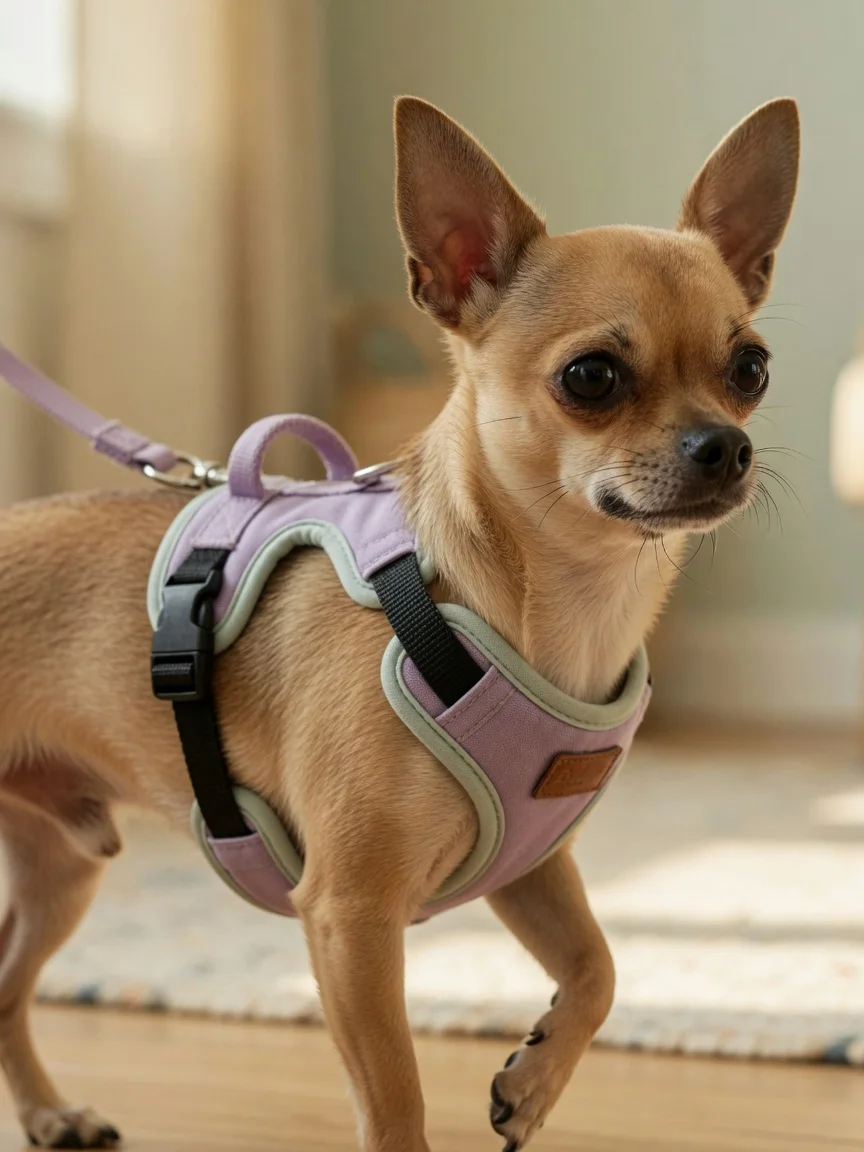
Fit beats brand every time, and the checklist is short. Shape: a Y-front or step-in style that leaves the throat completely clear; avoid anything with a strap cutting straight across the windpipe, which quietly recreates the collar problem in harness costume. Snugness: two fingers flat under every strap, no more, no less; chihuahuas are escape artists in loose harnesses and chafe in tight ones.
Armpits: the girth strap sits a finger's width behind the front legs, because rubbing there is the most common fit failure. Weight: everything scaled to the dog, small buckles, soft edges, mesh over armor; a four-pound dog does not need mountaineering hardware. Check fit monthly on puppies and after every grooming or weight change, per the body-condition habit from our weight guide.
Introduce it like a trick rather than an ambush: harness appears, treats rain, one leg in, treats, both, treats, off. Two short sessions and the harness predicts walks and cheese, the same low-drama onboarding as everything else in the leash guide.
The leash and the rest of the kit
A light four-to-six-foot leash with a small clip is the daily driver; heavy hardware bangs a small dog's shoulders with every step. A long line earns its keep for recall training and sniffy field time. Retractables stay on the shelf for the reasons the leash guide lays out: constant tension teaches pulling, thin cords tangle tiny legs, and the mechanism fails at precisely the wrong moments. Skip slip leads, choke chains, and prong hardware entirely at this size; there is no version of those tools that belongs on a chihuahua, a position consistent with the humane-equipment standards in the AVSAB position statements.
When to call your veterinarian
Same-day call: coughing, honking, or gagging that persists after switching to a harness, or any breathing change on walks, per the breathing guide. Routine appointment: recurring chafe spots or bald patches under straps, which are a fit problem with a skin consequence. Gear territory: everything else, ten minutes of fitting, two days of treats, done.
Frequently asked questions
Can my chihuahua wear a collar at all?
Yes, and she should, for identification: flat, light, snug enough not to slip over the head, tags attached. The rule is narrower than collar bans suggest: the collar carries the tag; the harness carries the leash. Both, each to its job.
What kind of harness is best for a chihuahua?
Any well-made Y-front or step-in that fits: throat completely clear, two-finger snugness everywhere, girth strap clear of the armpits, hardware scaled small. Fit and shape outrank brand and price, and the ten-minute try-on tells you more than any review.
Are retractable leashes bad for chihuahuas?
For training, yes, and for streets, mostly: they teach constant leash tension, tangle easily at ankle height, and fail under sudden load. A fixed light leash for pavements and a long line for open sniffing cover every legitimate use with none of the failure modes.
My chihuahua freezes when the harness goes on. Now what?
She learned the harness predicts wrestling. Rewind: harness on the floor, treats around it, then touch-and-treat, one leg, both, clip, all across a few short sessions, walks resuming only when the gear is boring. Checking fit is worth it too; freezing is sometimes just a chafing strap's only available complaint.
Harness for the leash, collar for the tag, two fingers under every strap, and nothing that squeezes a throat the width of your thumb: the whole debate, settled in a paragraph, with a decade of easy breathing as the dividend.




No comments yet
Leave a comment