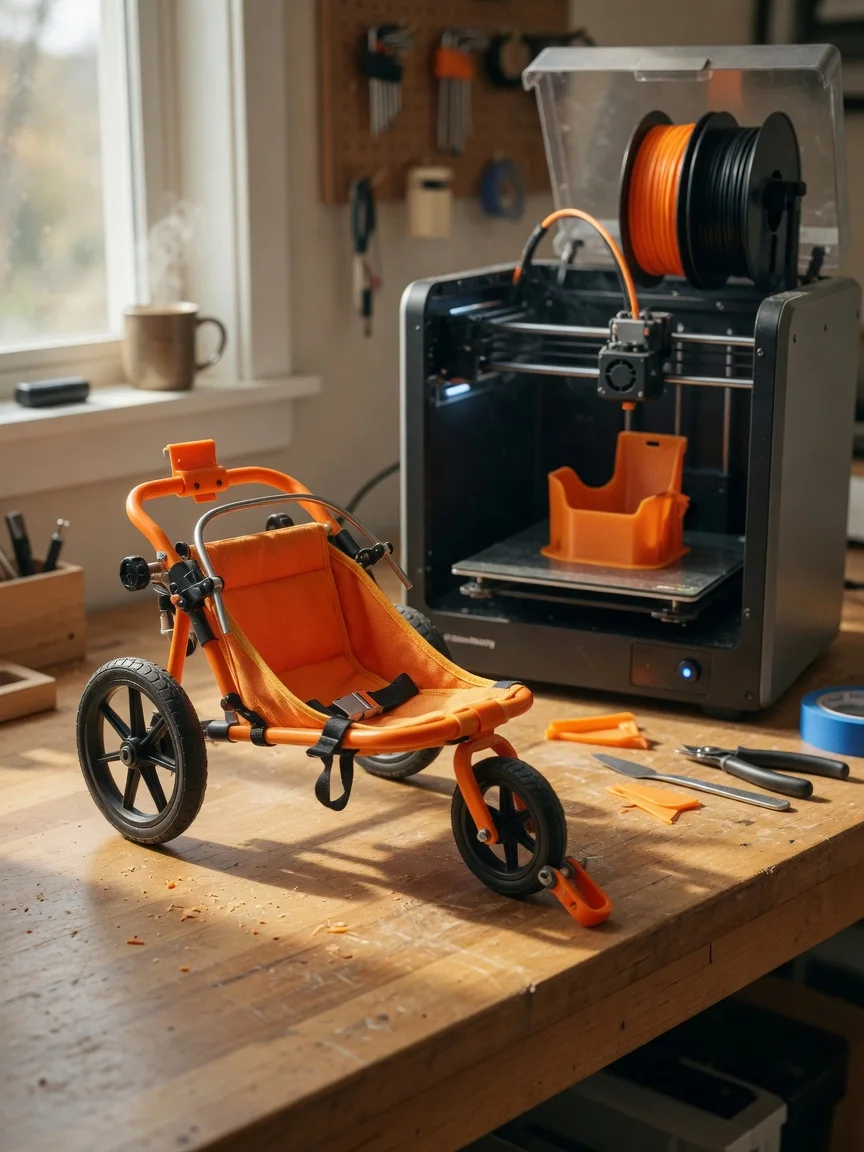
The cart that made a chihuahua briefly famous was bright orange, small enough to hold in one hand, and designed by a man who never met the dog. Mark Deadrick, president of the San Diego design firm 3dyn, estimated the measurements from photographs he found online, modeled a frame, and printed it on a MakerBot.
TechCrunch reported on August 8, 2014 that he gave the result away and left the design open for anyone to copy or modify. The dog was a puppy in Indianapolis, born without front legs, known online as TurboRoo. More than a decade later, that orange shell is still what people remember.
Quick answer: The cart that made a chihuahua briefly famous was bright orange, small enough to hold in one hand, and designed by a man who never met the dog: Mark Deadrick of the San Diego firm 3dyn estimated the measurements from online photographs, modelled a frame, and printed it on a MakerBot. He gave it away and left the design open for anyone to copy. The dog was TurboRoo, a puppy in Indianapolis born without front legs. Printed carts of that kind ran roughly $300 in 2015.
A puppy without front legs, and a clinic that said no to euthanasia
TurboRoo was born missing both front limbs and arrived at The Downtown Veterinarian in Indianapolis. He was adopted by Ashley Looper, a technician at the practice, according to designboom's August 2014 report. ABC7 Los Angeles later reported that some veterinarians had recommended euthanasia before Looper took him home.
What happened next was improvisation. Looper and her boyfriend built the first rigs themselves, small wheeled scooters assembled from odds and ends, ABC7 reported. They worked well enough to prove the idea and poorly enough to prove the need. That is where most stories about very small disabled dogs stall: the owner sees exactly what the dog requires, and nothing manufactured fits a body that weighs less than a bag of sugar.
Looper ran an online fundraiser for a proper cart. Deadrick, two time zones west, saw it and volunteered.
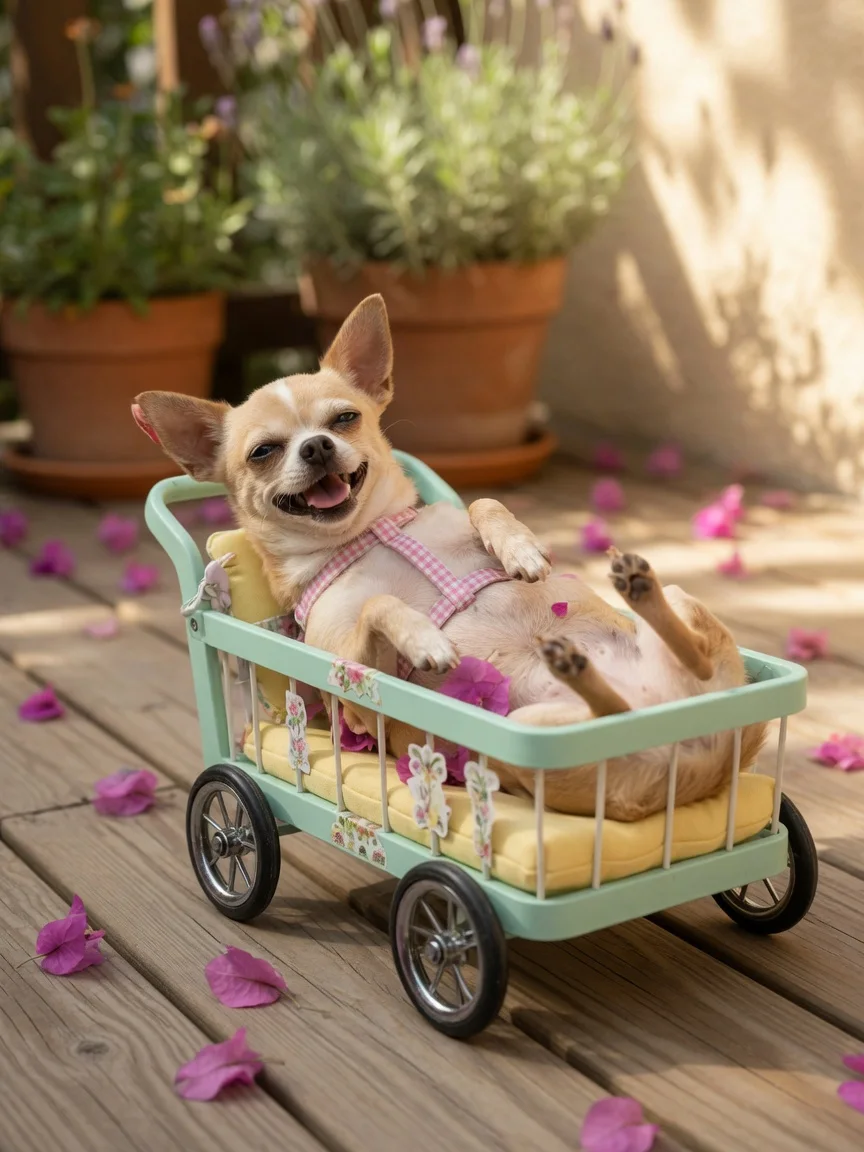
The cart itself, including the parts that do not agree
By the time the campaign was running, TurboRoo was about six months old, designboom reported. Deadrick's answer was a printed front frame with a harness around the chest and shoulders, riding on two small commodity wheels. The accounts do not agree on the hardware; TechCrunch described Rollerblade wheels, designboom described skateboard wheels. It is a small open question in an otherwise well documented story.
The wheels are not really the point. The method is. Conventional carts get fitted, ordered, and outgrown; a printed shell can be run again a size larger, which solves the hardest problem with mobility gear for a dog who is not finished growing.
Why a front-support cart is harder than it looks
Most dog carts address hind-end weakness. The American Kennel Club's guidance on wheelchairs for dogs describes three designs: rear-support, a triangular front-support cart for front-limb weakness, and quad-support. TurboRoo needed the second kind, which puts a dog's forward weight into a chest and shoulder harness rather than a pelvic sling.
That distinction shows up in the injury data. A 2024 study in Frontiers in Veterinary Science by Narum, Miscioscia, and Repac gathered 1,221 caretaker reports on assistive mobility carts, 954 of them on dogs. Sixty-two percent of dog owners reported improved quality of life for the animal.
But 64 percent reported at least one complication, and wounds accounted for 53 percent of those: inner thigh at 28 percent, upper front leg and armpit at 22 percent, tops of the paws at 14 percent. For a dog carrying his weight on a front harness, that armpit figure is the one to watch.
AKC's guidance, credited to chief veterinary officer Dr. Jerry Klein, is that a veterinarian or certified veterinary physical therapist should advise which design suits an individual dog. Fitting means measuring hip width, body length, height at the withers, and weight, then checking that two fingers slide under every strap. Tighter risks pressure sores; looser chafes.
The unglamorous work after the gear arrives
Best Friends Animal Society's wheelchair FAQ makes two points owners skip. A dog should never be left unattended in a cart; tipping and getting wedged are ordinary occurrences, not freak accidents. Carts are also not meant for long stretches, but for a walk or play session, after which the dog comes out and rests. A veterinarian may also advise against a cart entirely so the dog builds strength on his own. Most dogs adjust within a few days; a small number never accept one.
For chihuahua owners the fit problem compounds. A four-pound frame has little margin, which is why our harness and collar comparison keeps returning to pressure distribution, and why an orthopedic issue like patellar luxation changes a dog's gait long before anyone reaches for wheels. Approach mobility gear the way you would our gear guide: measure first, buy second, expect to adjust.
What the wheels turned into
The story traveled fast. In January 2015, ABC7 covered a meet-and-greet at a Long Beach, California pet store where TurboRoo appeared with newer wheels. Looper told the station that what she wanted people to take from his story was "that you never give up."
The more durable outcome was structural. The trade publication 3DPrint.com reported on February 11, 2015 that a venture called TurboRoo Designs had partnered with the subscription company BarkBox to fund carts for ten more two-legged dogs, at roughly $300 each, printing contracted to a local hobbyist after the group's MakerBot Replicator failed. One dog's problem had become a small production line for other people's dogs, which is the part of these stories that usually goes unreported.
What is not documented is the rest of his life. His current status does not appear in any reporting I could verify, and the coverage thins after 2015. There is no confirmed ending to give you.
Frequently asked questions
Can a dog born without front legs walk without a cart?
Many move independently, hopping or balancing upright on their hind legs, and TurboRoo got around on homemade rigs before the printed cart existed. Whether that should be encouraged long term is a veterinary question, since sustained two-legged movement loads a spine and pelvis in ways they were not built for. Ask a veterinarian or rehabilitation specialist.
How much does a mobility cart for a small dog cost?
It varies widely by design and fit. For scale, 3DPrint.com reported the printed TurboRoo Designs carts at roughly $300 each in 2015. Carts fitted through a rehabilitation practice generally cost more, and a growing puppy needs more than one.
How do I know if the cart fits correctly?
The AKC's benchmark is that two fingers should slide under any strap. Beyond that, check the skin under the harness after every session, particularly the armpits and inner thighs, since the Frontiers in Veterinary Science survey found wounds to be the most common complication reported.
The thing worth taking from 2014 is not that a stranger printed a cart, though he did. It is that a technician at an ordinary clinic decided a dog with two legs was worth the trouble, and then an engineer, a hobbyist with a printer, and a company that mails dog treats each solved one piece of a problem nobody had assigned them.
That is how most disabled animals actually get helped, and it starts the way TurboRoo's did: with one person at a clinic declining to accept the recommendation. Our rescue adoption guide and our notes on measuring quality of life cover the same judgment call in quieter circumstances.



No comments yet
Leave a comment