
Somewhere on the internet right now, a chihuahua owner is reading that their breed ranks unimpressively on the famous dog-intelligence list, while the dog in question, having trained three humans to provide couch access, snack tariffs, and a heated lap on demand, watches them read it. The gap between those two facts is the entire subject. So the honest place to start is defining the disputed term, because dog intelligence is not one measurement, and the one that made the rankings famous is the one chihuahuas care about least.
Quick answer: Chihuahuas rank modestly on the famous obedience-based intelligence rankings, which measure how fast a breed obeys a first command, a herding-breed specialty rather than a general measure of mind. On social and adaptive intelligence, reading people and arranging outcomes, the breed does conspicuously well. They are easy to teach and selective about complying for free, so short, well-paid sessions work and unpaid labor gets negotiated hard.
What the rankings actually measure
The best-known intelligence hierarchy in dogdom comes from psychologist Stanley Coren's The Intelligence of Dogs, first published in 1994, which ranked breeds substantially on working-and-obedience intelligence: how quickly a breed learns a new command and how reliably it obeys the first ask.
Coren's own framework, as the American Kennel Club's overview of the smartest breeds lays out, actually splits canine intelligence three ways, instinctive, adaptive, and working-and-obedience, but the famous league table ranks only the third kind. It is a real measurement of a real thing, and that thing is compliance speed, a trait bred hard into herding and retrieving dogs whose ancestors' jobs required taking orders at a distance.
Chihuahua ancestors, per our origins guide, held a different portfolio, professional companionship, where the valuable skills were reading people, negotiating households, and being unignorable. Ranked on take-orders-fast, companion breeds land mid-pack or lower. Ranked on run-a-household-from-four-pounds, the list would invert.
The kinds, and where the breed actually scores
Social cognition: elite. Chihuahuas are professional people-readers, tracking gaze, tone, posture, and household routine with the dedication our love-signals guide documents. This is not owner flattery: VCA Animal Hospitals' primer on canine communication puts it plainly, people are listeners and dogs are watchers, and research keeps suggesting that dogs read our subtle cues, emotions, and intentions rather better than we read theirs. Companion breeds live at the applied end of that science. Your chihuahua may not sit on the first ask; she knew you were leaving the house before you did.
Adaptive intelligence: strong. Problem-solving in service of goals: the learned door-handle stare, the fake potty request that relocates you from the desk, the precise triangulation of which human folds first at dinner. Owners file these under mischief; they are cognition, aimed, as ever, at the breed's historical job of managing its people.
Working obedience: mid-table, honestly. Not because the hardware is missing, chihuahuas learn cues fast when the wages are real, as our first-cues guide demonstrates in five-minute sessions, but because the breed ships with an independent streak and a keen sense of whether compliance currently pays. Trainers call it stubborn; an economist would call it rational. The fix is not a smarter dog, it is a better payroll, and word-learning studies in dogs suggest vocabulary capacity far beyond what most owners ever bother to install.
The practical upshot
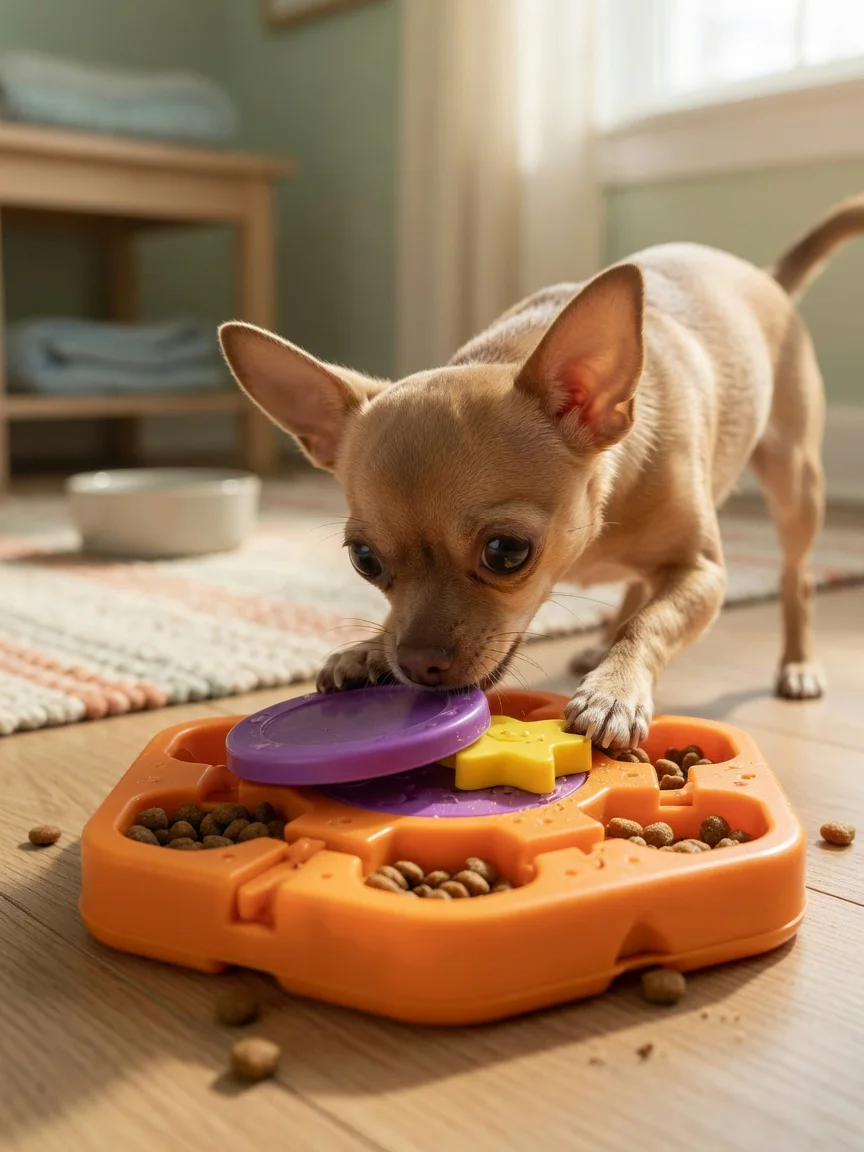
Treat the breed as smart-but-self-employed and everything in the training library clicks. Short paid sessions beat long drills, and the pay matters more than the lecture: the American Veterinary Society of Animal Behavior recommends reward-based methods for all dog training, which for a chihuahua simply formalizes the wage negotiation already in progress. Boredom is the enemy, an under-occupied intelligent dog invents projects, usually load-bearing ones, per our chewing guide, and enrichment is not a luxury for a brain this busy.
The stereotype pipeline runs exactly as our aggression guide describes: an untrained clever dog in a permissive household looks dumb and acts feral, while the same dog with five minutes of daily employment looks like what she is, one of the sharpest small operators in dogdom, currently accepting applications for staff.
Frequently asked questions
Where do chihuahuas rank in dog intelligence?
Modestly on the famous obedience-based rankings, which measure first-command compliance, a herding-breed specialty. On social and adaptive intelligence, reading people and solving household problems, they perform far better, which any owner audited by one at dinner can confirm.
How many words can a chihuahua learn?
Dogs generally can learn vocabularies in the dozens to well over a hundred words and phrases with deliberate teaching, and exceptional individuals have demonstrated far more. Most chihuahuas know exactly as many words as their household bothered to install, plus several the household wishes it had not, walk and cheese leading the census.
Are chihuahuas easy to train?
Easy to teach, selective about complying for free: they learn cues quickly in short, well-paid sessions and negotiate hard against unpaid labor. Treat training as employment rather than obedience and the breed performs; the longer answer lives in our trainability guide.
Is my chihuahua smarter than she acts?
Almost certainly: acting unimpressive while arranging outcomes is the breed's signature move. A dog who has secured couch rights, meal-time leverage, and a personal human transportation service without learning to fetch has not failed the intelligence test; she has declined to take it.
Smart, then, with an asterisk the rankings never print: intelligence in service of her own agenda, shaped by centuries of managing people rather than sheep. Give the brain a job, pay it properly, and enjoy sharing a house with a mind that small, that busy, and that thoroughly convinced it holds the senior position.




No comments yet
Leave a comment