
Chihuahuas can swim, in the narrow sense that a healthy one dropped into water will paddle. Whether she should is a different question with a more useful answer: yes, sometimes, briefly, supervised, and ideally wearing flotation, because everything that makes this breed portable also makes it bad at endurance in water. The American Kennel Club's swimming guidance is blunt that not all dogs are natural swimmers, and small dogs in particular tire quickly. This is the service version of the whole subject: ability, equipment, venues, session length, and the aftercare that prevents the second-order problems.
Quick answer: A healthy chihuahua dropped in water will paddle, but the spec sheet works against her: low body fat means little buoyancy and fast heat loss, and a few minutes of hard paddling is a genuine workout at four pounds. So the honest answer is yes, sometimes, briefly, supervised, and ideally in a flotation vest. Two to five minutes with rest between rounds is plenty for a fit adult. Bring fresh drinking water, since the trouble usually comes from drinking pool or sea water.
What a chihuahua brings to the pool
The paddling instinct is real, but the spec sheet works against her. Low body fat means little buoyancy and fast heat loss, a small body means a few minutes of hard paddling is a genuine workout, and the same cold sensitivity that runs through our temperature guide applies double in water, where heat leaves the body far faster than in air.
Panic is the other variable: a dog introduced to water badly, dunked or thrown in as a joke, learns fear in one lesson and may thrash instead of paddle ever after. None of this makes water off-limits. It makes water an activity you run like the short, supervised event it is, and for plenty of individual chihuahuas who simply hate it, the correct venue is a dry towel at a safe distance, an opinion this site respects, per the beach guide.
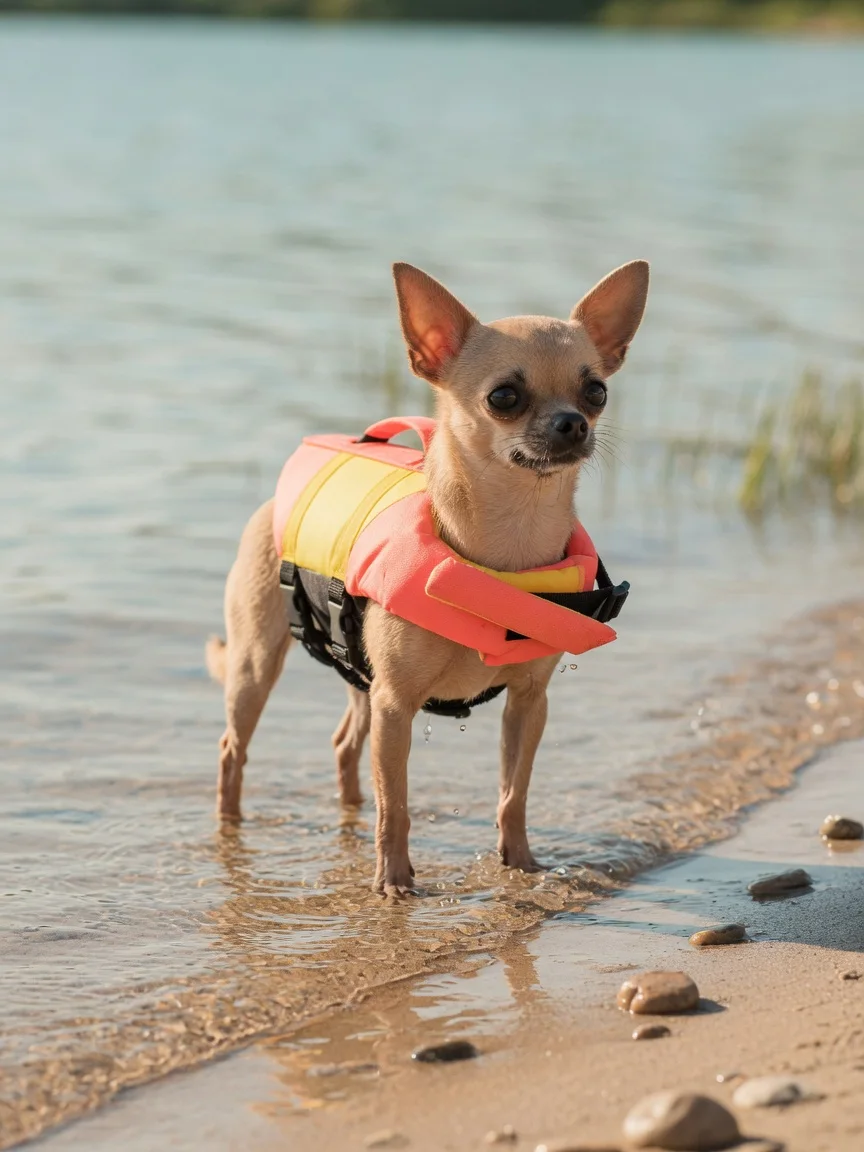
The equipment case: a life jacket, fitted, always
For open water and pool sessions alike, a dog life jacket in the smallest sizes solves most of the physics at once: buoyancy she lacks, bright visibility, and a top handle that lets you lift four pounds out of trouble in one motion. The AKC's life jacket guidance notes that even strong swimmers tire and benefit from flotation, and a chihuahua is not a strong swimmer.
Fit matters at this scale: snug enough not to rotate, loose enough for free shoulder movement, checked in shallow water before it is trusted in deep. Let her wear it dry at home with treats first, the same gradual-introduction logic as every other piece of equipment in the harness guide.
Venue rules
Pools are the most controllable venue and the most dangerous unsupervised: the ASPCA's warm-weather guidance is categorical that pets should never be left unsupervised around a pool. Teach her where the steps are from the first session, since a dog who falls in and cannot find the exit swims until she cannot, and fence or cover the pool when nobody is on lifeguard duty. Do not let her drink pool water.
Lakes and rivers add currents, drop-offs, boats, and murky water where a four-pound dog vanishes from view; flotation and a long line are non-negotiable, and skip water that looks scummy or stagnant entirely. The sea adds waves that outmatch her completely and salt water that punishes drinking; work the wet sand line, not the surf. In every venue, hawks and gulls regard a swimming chihuahua the way they regard a walking one, so the supervision is total.
Session length and the exit signs
Think minutes, not laps. Two to five minutes of actual swimming is a serious workout for a dog this size, repeated only if she is visibly keen. End the session at the first sign of lag: slower strokes, hind end riding lower, heading for the exit, climbing at you, or shivering, which in water arrives fast and means done regardless of her enthusiasm.
Afterward, rinse the chlorine or salt out of her coat with fresh water, dry her thoroughly per the drying protocol in our bathing guide, and dry the ears gently, since trapped moisture sets up the ear trouble our grooming guide works to prevent. A post-swim chihuahua in a warm towel is also a strong argument for the whole enterprise having been worth it.
Frequently asked questions
Do chihuahuas like to swim?
Individually decided: some paddle with visible enthusiasm, many prefer supervising from shore, and forcing the reluctant ones teaches fear rather than skill. Offer shallow, warm, gradual introductions with treats, respect a consistent no, and remember the breed loses nothing by preferring dry land.
How long can a chihuahua swim for exercise?
A few minutes at a time is a genuine workout at four pounds. Two to five minutes of swimming, with rest between rounds, is plenty for fit adults, and the session ends at the first slower stroke, low-riding hind end, or shiver. As a workout it is excellent and joint-friendly; as an endurance sport it is not hers.
Can chihuahua puppies or seniors swim?
Puppies can learn water confidence in shallow, warm, brief sessions once vaccinated, always in flotation. Seniors and dogs with heart or breathing conditions, per our breathing guide, need a veterinary conversation first, since water stress lands hardest on compromised systems. When in doubt, paddling-depth wading delivers most of the fun at a fraction of the risk.
Is chlorine or salt water bad for chihuahuas?
Brief, supervised exposure is fine for most dogs; the problems come from drinking it and from residue left in the coat. Bring fresh drinking water so the pool is not the water bowl, rinse her after every session, and dry ears and coat thoroughly. Red eyes or an upset stomach after swimming earns a veterinary call.
So: yes, she can swim, for minutes, in a vest, under eyes that never leave her, followed by a rinse, a towel, and in most cases a strong personal preference for the towel. Water safety at four pounds is mostly the art of making the asterisk bigger than the yes.



No comments yet
Leave a comment