
Love matters when adopting a sick senior Chihuahua, but a safe placement also depends on medical records, realistic resources, home preparation, and a dependable care team.
The phrase “perfect dad” promises a neat ending. The available evidence does not.
No reliable original report could be matched to the claim that a sick Chihuahua found a particular perfect adopter. Searching the exact slug, reconstructed title, variants, archives, rescue pages, and syndications did not establish the dog’s identity, illness, caregiver, or outcome. Those missing facts cannot be filled with a sentimental guess.
A documented story does show what a medically complex adoption can require. Best Friends Animal Society reported that Griff, a senior Chihuahua, was living with kidney and liver problems, heart disease, degenerative disc disease, and a history of seizures when Vanessa and Josiah decided to bring him home.
Their example supports a practical question: what does a sick senior Chihuahua need from any adopter?
Quick answer: No, no verified report exists of a sick senior Chihuahua finding a perfect adopter. A documented case from Best Friends Animal Society involved Griff, a senior Chihuahua with kidney and liver problems, heart disease, degenerative disc disease, and seizures, adopted by Vanessa and Josiah. A sick senior Chihuahua needs complete veterinary records, medication lists, test results, diagnoses, a realistic care budget, home modifications, prompt veterinary handoff, pain monitoring, quiet pacing, and a prepared support team rather than sentimental promises.
Start with records, not a rescue fantasy
An adopter should receive the dog’s available veterinary records, medication list, recent test results, diagnoses, diet, mobility notes, behavior observations, and emergency history. Ask which findings are confirmed, which are suspected, and which still need workup.
Request a plain-language discussion with the shelter veterinarian or the dog’s regular clinic when possible. Learn what is stable, what could deteriorate quickly, and what signs require an urgent visit.
An affectionate meeting cannot answer those questions. A Chihuahua may wag, cuddle, eat treats, and still have pain, organ disease, dental infection, seizure risk, or difficulty regulating body temperature.
The adopter also needs permission to be honest. If the expected care exceeds the household’s money, schedule, strength, housing rules, or emotional capacity, declining may be the responsible choice. A sustainable placement protects the dog better than a promise made under pressure.
Price the first month and the hard month
Routine costs may include examinations, laboratory monitoring, prescription food, medication, dental care, parasite prevention, grooming help, transport, washable bedding, ramps, nonslip flooring, and incontinence supplies.
Then plan for the difficult month: an emergency examination, imaging, overnight care, a changed prescription, or a mobility device. Ask the rescue whether it provides post-adoption support, discounted care, medication, or a trial or foster-to-adopt arrangement.
Pet insurance may exclude pre-existing conditions. Savings, a veterinary payment plan, rescue support, or a dedicated care fund may therefore matter more. Read actual policy terms rather than assuming a new policy will cover an established illness.
Money is only one resource. A dog who needs medication three times a day requires a reliable schedule and backup person. A dog who cannot climb stairs may need safe lifting at every toilet break.
Build a veterinary handoff
Schedule a first appointment with the adopter’s veterinarian promptly, using the timing recommended by the rescue. Send records before the visit so the clinic can review them without relying on memory.
Bring every medication in its labeled container. Do not stop, split, combine, or replace prescriptions because the dog seems better. Supplements, over-the-counter pain medicine, and human medication can interact with disease or treatment and may be toxic.
AAHA’s senior-care guidance emphasizes individualized evaluation and monitoring. For one dog that may mean blood pressure and kidney values; for another, pain, mobility, heart function, seizures, dental disease, vision, hearing, or cognitive changes.
Create a written list of normal patterns during the first week: appetite, water intake, urination, stool, sleep, breathing at rest, movement, interest in contact, and medication times. A baseline helps the veterinary team interpret a later change.
Let the Chihuahua set the pace
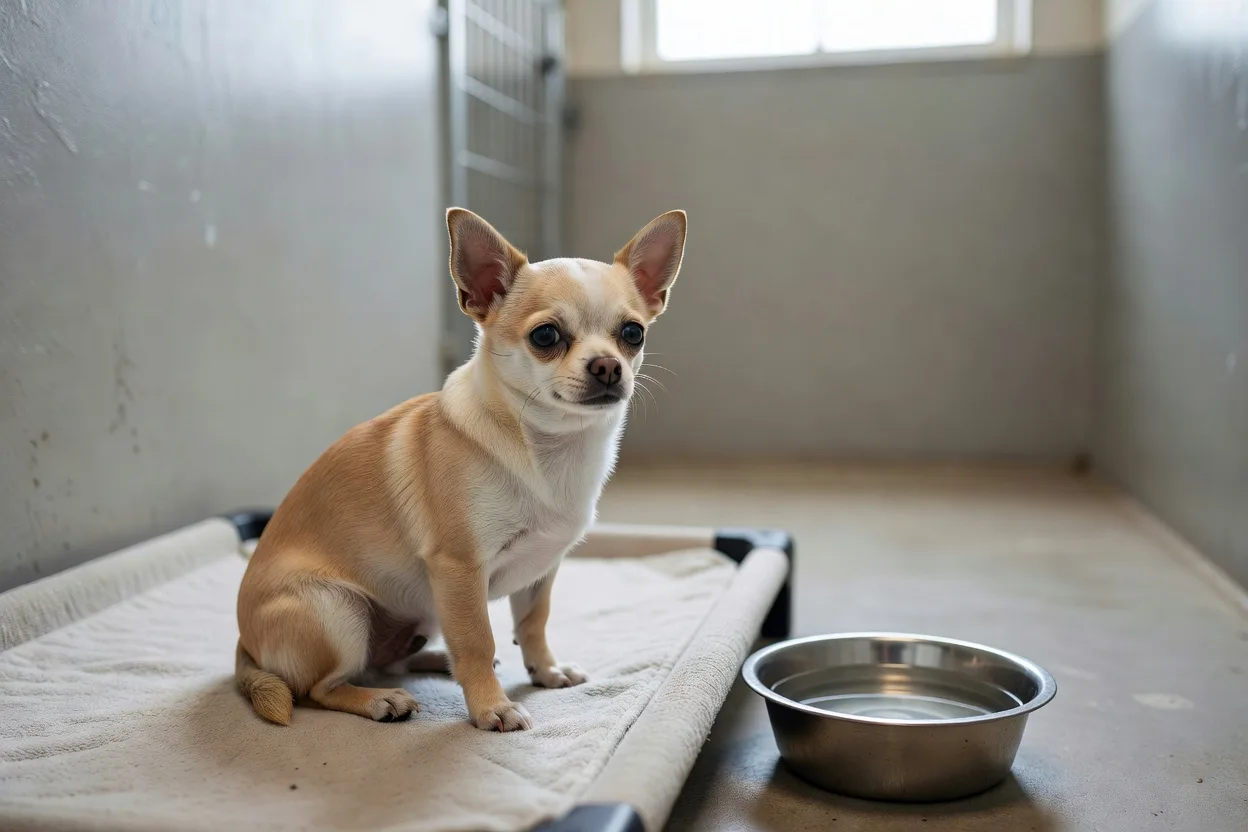
A newly adopted senior may need quiet more than entertainment. Give the dog one warm, low-traffic resting area with water nearby and a clear route to the toilet area. Use gates to prevent falls, cover slippery floors, and block furniture jumps.
Introduce people and resident animals gradually. Do not pass a frightened Chihuahua from lap to lap or stage an emotional welcome video. Turning away, freezing, lip licking, trembling, hiding, panting at rest, and trying to escape can signal that the dog needs distance.
Short, supported exploration is often more useful than a long walk. A veterinarian can advise on activity for the dog’s heart, spine, joints, weight, and current stamina.
Use a secure, well-fitted harness when appropriate and check that it does not rub. For travel, use a properly restrained carrier or tested restraint rather than holding the dog in a passenger’s arms.
Treat pain and quality of life as daily questions
Pain is not always a cry. A Chihuahua may sleep differently, resist being picked up, hesitate before stairs, stop grooming, guard a body part, breathe faster, eat less, or become unusually withdrawn or irritable.
AAHA advises caregivers to discuss pain changes with the veterinary team. Videos of the dog rising, walking, eating, and using stairs can help show what happens at home, but they do not replace an examination.
Quality of life includes comfort, appetite, hygiene, rest, mobility, social interest, and the ability to enjoy familiar activities. Track good and difficult days in a simple calendar. Ask the veterinarian in advance which changes should trigger a same-day call and how end-of-life decisions would be approached.
Planning is not giving up. It prevents a crisis from forcing decisions while everyone is frightened.
Give caregivers support too
Medical care can be exhausting. Divide tasks among trusted adults, keep instructions where a backup caregiver can find them, and store the clinic and emergency numbers in more than one phone.
Ask for help before fatigue becomes resentment or medication errors. Respite care, veterinary technicians, experienced pet sitters, rescue volunteers, and family can sometimes cover appointments or short breaks.
Griff’s documented story included people willing to learn his needs instead of asking him to become an easy dog. That is a stronger measure of fit than the word “perfect.”

Tell an honest adoption story
The photographs of Griff on the Best Friends page remain copyrighted and reference-only. The licensed Chihuahua images in this package are illustrations and do not show him or the unidentified dog from the slug.
If the original sick-Chihuahua story is later located, verify the dog’s name, rescue, diagnosis, adopter, dates, and outcome before updating the article. Do not turn a private medical condition into invented drama.
A prepared adopter may be loving, patient, financially ready, and deeply committed without being flawless. What a sick senior Chihuahua needs is more concrete: accurate information, accessible veterinary care, a safe home, a realistic daily plan, and someone who will keep listening when the dog’s needs change.
Featured photograph: Zarate123 / Wikimedia Commons (CC BY-SA 4.0), via Wikimedia Commons. It is an illustration and does not depict the animals described in this article.




No comments yet
Leave a comment