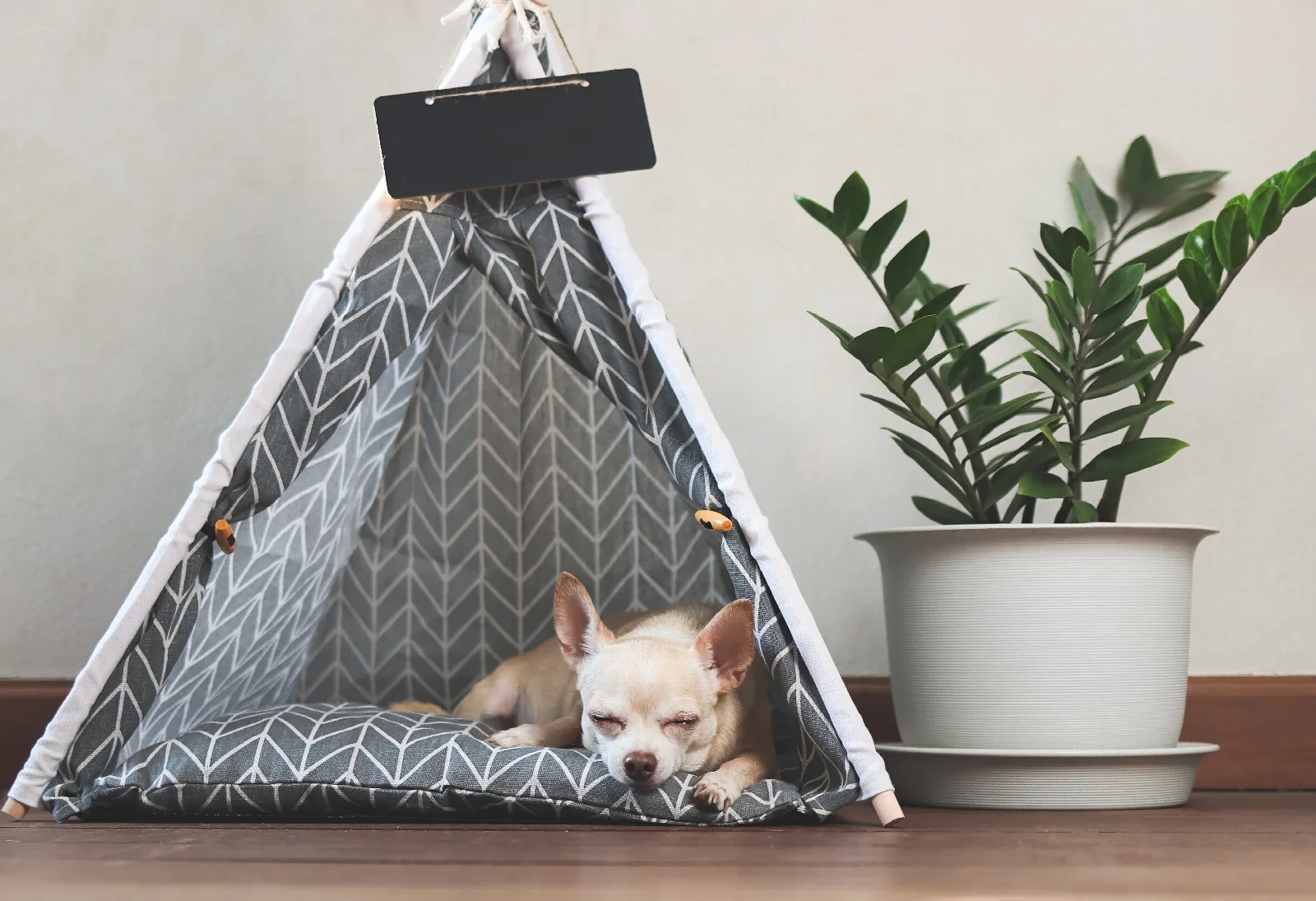
New chihuahua owners tend to report it as a mystery: the dog disappears, panic ensues, and the dog is eventually located inside the sofa cushions, under three blankets, radiating smugness. Burrowing is not a quirk of your individual dog. It is standard chihuahua operating procedure, it is healthy, and the only real work it asks of you is one safety habit and, ideally, a better den than your laundry pile.
Quick answer: Burrowing is standard chihuahua operating procedure rather than a quirk of your individual dog, and it is healthy. Two drives stack: a four-pound body sheds heat fast and a blanket cave traps it, and the circling and digging beforehand is ancient nest-building behavior running on a duvet. It is safe for a healthy adult under ordinary breathable bedding, with lighter blankets for unsupervised time. A sudden increase in hiding is a different signal, and pain, fear, or illness should be ruled out.
Why the smallest dogs dig the deepest
Two drives stack. The first is heat. A four-pound body sheds warmth quickly, which is the same physics that runs our cold-weather guide, and a blanket cave is a self-serve solution: trapped body heat, walls, roof. Watch when the burrowing intensifies, cool evenings, tile floors, winter, and the thermostat theory mostly proves itself.
The second is security. Enclosed, den-like spaces are calming equipment for dogs generally, small dogs especially: pressure of fabric, dim light, and a defined boundary read as safety to an animal whose wild ancestors raised puppies in dens and whose modern self weighs less than the household cat. A dog who beds down under cover sleeps deeper because she is not on sentry duty. That is also why burrowing often spikes in busy households, after moves, or around fireworks season; the den is a coping tool, and a good one.
Add a third, smaller driver: it simply works socially. A chihuahua under the throw blanket on your lap gets warmth, contact, and proximity to the favorite human in one move, a package our between-the-legs guide covers from a neighboring angle.

The one safety rule, and it is not optional
Check before you sit, and check before you flop. A burrowed chihuahua is invisible under a duvet or between couch cushions, and an adult human landing on a hidden four-pound dog is a genuine emergency, not a comic mishap. Make the pat-down a household reflex, brief guests on it, and teach children that lumps in blankets get checked, never jumped on. Corollary rules: know where the dog is before folding sofa beds, closing recliners, or tossing laundry piles into machines. Every experienced small-dog household runs these checks on autopilot; adopt them on day one.
On the suffocation worry that new owners raise: healthy adult dogs reposition themselves when air runs low, and blanket burrowing under ordinary bedding is widely regarded as safe. Sensible caveats still apply: lightweight, breathable blankets rather than heavy sealed duvets for unsupervised time, and extra caution with very young puppies and frail seniors, who have less strength to rearrange their own architecture.
Build a better den than the laundry pile
You can meet the drive on purpose, which is classic environmental enrichment, the everyday welfare tool the ASPCA's behavior resources keep returning to. The kit is cheap: a covered or cave-style dog bed, or an open bed plus a dedicated soft blanket the dog is allowed to excavate; placement in a draft-free corner with household sightlines; and a couple of rewarded rehearsals, treat tossed in, calm praise, so the den becomes the dog's own good idea.
A burrower with a sanctioned den still visits your duvet, but the three a.m. digging expeditions on your legs tend to shrink, and travel gets easier too, because the den blanket goes wherever the dog goes and smells like home when it arrives.
One training note in the other direction: never use the den as a punishment location. Its entire value is that nothing bad happens there.
When burrowing changes meaning
The behavior itself is benign; changes in it are information. A dog who suddenly starts hiding for long stretches, especially one who was not much of a burrower before, may be cold, anxious, or unwell, and pain is the quiet driver owners most often miss.
Pair sudden hiding with any appetite, energy, or bathroom change and it becomes a veterinary question, per the patterns in our watch-for guide. And a dog who burrows to escape a specific household member or event is handing you a behavior flag worth taking seriously rather than laughing off; our fearful-dog guide is the companion read there.
When to call your veterinarian
Same-day call: hiding plus lethargy, appetite loss, vomiting, or any sign of pain when touched. Routine appointment: a marked personality shift toward hiding, or burrowing paired with weight or coat changes. Training territory: ordinary cozy burrowing, evening cave construction, and the annual winter intensification, all of which are the breed working as designed.
Frequently asked questions
Is it safe for my chihuahua to sleep under the covers?
For a healthy adult under ordinary breathable bedding, yes; dogs reposition when they need air. Use lighter blankets for unsupervised time, be more careful with puppies and frail seniors, and enforce the check-before-you-sit rule for the humans, who are the actual hazard in the arrangement.
Why does my chihuahua dig at the blankets before lying down?
Nest-building. The circling and digging routine is ancient bedding-preparation software, fluffing the substrate and checking the site, running on a duvet instead of prairie grass. It needs no fixing, though a dedicated diggable blanket saves your good linens.
My chihuahua suddenly hides all the time. Should I worry?
A sudden increase in hiding is a change in signal, and pain, fear, and illness are the candidates to rule out in that order. Book a veterinary check, then look at what changed at home: schedules, visitors, noise, a new pet. Sudden is the operative word; lifelong burrowers are just being chihuahuas.
Should I get my chihuahua a covered bed?
If she burrows, she will likely love one: cave beds, teepees, and pocket-style beds meet the drive ready-made. Introduce it with treats and zero pressure, keep it in a draft-free spot with a view of the household, and let her decide the laundry pile has been outclassed.
Burrowing is one of the breed's most honest behaviors: a small, quick-cooling, softly armored animal building the warm fortress her body has always voted for. Provide the fortress, pat the cushions before you land, and everyone sleeps better, especially the management.



No comments yet
Leave a comment