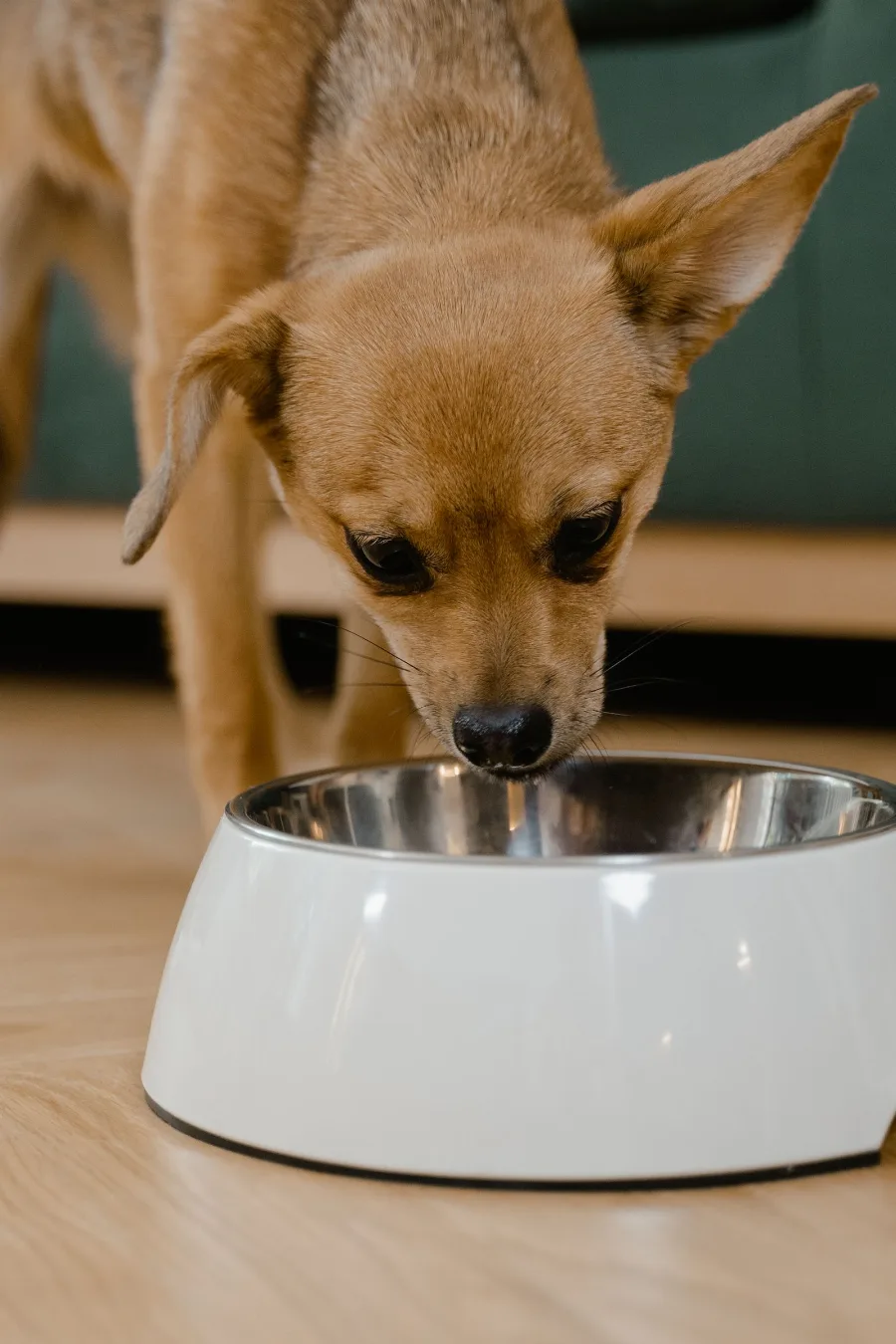
A chihuahua who will not go near her water bowl is telling you something, and it is almost never fussiness. Bowl avoidance tends to fall into three groups: something hurts, something about the bowl or its surroundings is unpleasant, or the bowl has been paired with a fright and now predicts one. Those have different answers, so spend a day observing before you change anything. One rule holds throughout: never restrict water to encourage drinking. A four-pound dog has very little margin.
Quick answer: A chihuahua who will not go near her water bowl is telling you something, and it is almost never fussiness. Bowl avoidance falls into three groups: something hurts, something about the bowl or its surroundings is unpleasant, or the bowl has been paired with a fright and now predicts one. Sudden avoidance deserves a medical look first, and in this breed the mouth is the obvious suspect, since 80 to 90 percent of dogs over the age of three have some periodontal disease.
Start with the mouth, not the bowl
Behavior that appears suddenly deserves a medical look first, and in this breed the mouth is the obvious suspect. Cornell University's Riney Canine Health Center reports that 80 to 90 percent of dogs over the age of three have some degree of periodontal disease, that it runs worse in smaller breeds, and that by the time an owner notices a change in how a dog eats, it is usually already advanced.
A painful tooth root meeting cold water produces the exact pattern owners describe: she wants it, she leans in, she flinches, she leaves. A look at the gums at home will not settle it; the answer comes from an oral exam and dental radiographs, as our dental care guide explains.
Pain further back does the same job by another route, since lowering the head to floor level asks something of the neck and shoulders. New avoidance and undiagnosed pain travel together more often than owners expect. Fagundes and colleagues, in Frontiers in Veterinary Science in 2018, compared case histories from 20 dogs, half with musculoskeletal pain, and reported that the dogs in pain generalized their avoidance more broadly to the places where the frightening event had happened. The sample was small and the controls were not imaged, so treat it as a prompt rather than a rule: when avoidance is new, ask whether something hurts.
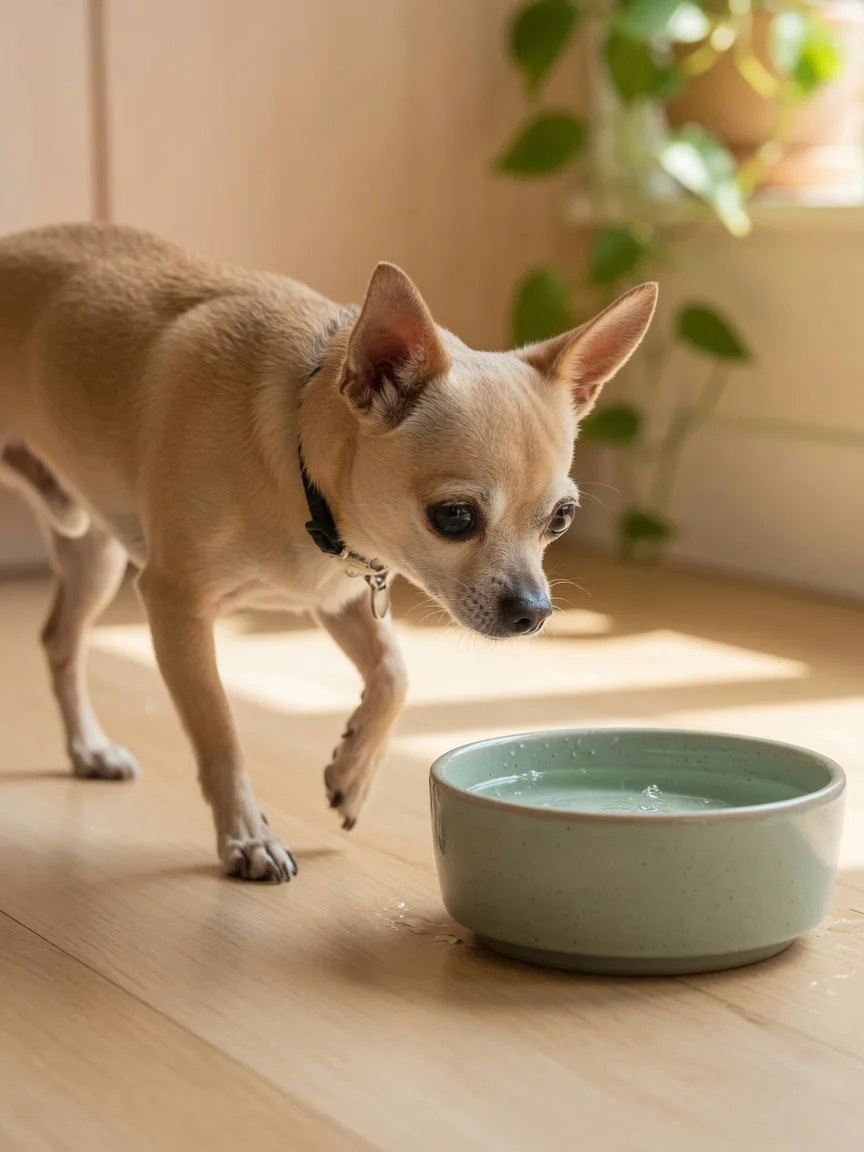
The bowl, the noise, and the room around it
If the mouth checks out, work through the physical variables one at a time, because a chihuahua meets a water bowl very differently than a spaniel does. A stainless bowl rings. An identification tag against the rim rings louder, right beside her ears. A lightweight dish slides on tile and chases her while she drinks.
A raised stand may sit awkwardly for a dog whose shoulder is eight inches off the ground. Deep, narrow bowls press against the sides of the muzzle, which is where the popular whisker-fatigue explanation comes from; that idea is discussed mostly in cats and is thinly supported in dogs, though a wider, shallower bowl costs nothing to try.
Then look at the neighborhood rather than the dish. A bowl parked beside a washing machine, an ice maker, a furnace vent, or a kitchen bin collects an association with whatever those appliances do without warning. A bowl in a corner leaves her drinking with her back to the room and no exit, which some dogs simply decline. A bowl inside another pet's territory turns drinking into a negotiation. Our gear guide covers materials and shapes; the cheaper experiment is to change one variable, give it three days, and write down what happened.
When the bowl starts predicting something bad
The third explanation is learning history. If something startling happened while she was drinking, a dropped pan, a vacuum starting, a larger dog arriving, the bowl can become a reliable predictor of that event despite causing none of it. Associations like this can form in a single trial and do not fade on their own, because she never gets close enough to learn otherwise.
The repair is desensitization and counterconditioning. Desensitization means presenting the trigger at an intensity she can handle; counterconditioning means pairing it with something she values so the emotional response has room to change. The American Veterinary Society of Animal Behavior's position statements are unambiguous that punishment adds fear rather than removing it, and fear is the entire problem here.
Give her water elsewhere first. Two or three extra stations in open, boring locations. Management is not failure, and she needs to drink today. Retire the suspect bowl. Different material, different shape, non-slip mat underneath, tags off at home so nothing rings. Remove every candidate at once and add them back later if you like.
Pay the approach and let it be her idea. No luring, no carrying her over, no hand on the collar. Scatter crumbs of something excellent at a distance where she stays loose and curious, then close the gap by a hand's width per session over several days, ending while she is still relaxed.
Never scold the hesitation; a retreat is information about distance, exactly as our fearful-dog guide describes. Measure instead of guessing. Mark a fill line, record the daily total, and track how long she hesitates and whether the original spot becomes usable again. Progress across a few weeks is normal.
When to call your veterinarian
Same day: refusal to drink for twelve hours or more in a dog this small, or avoidance alongside tacky gums, sunken eyes, lethargy, or vomiting. The American Kennel Club's dehydration guidance from chief veterinary officer Dr. Jerry Klein lists those among the signs of a dog who needs fluids rather than a training plan; our emergency visit guide covers that appointment.
Within the week: hesitation that arrived suddenly, bad breath, dropped food, pawing at the mouth, or a matching dip in appetite, which our appetite guide works through. A swing the other way, meaning a dog suddenly drinking far more than usual, deserves the same call. Ask about referral: panic-level fear near the bowl, or no movement after a month.
Frequently asked questions
Is whisker fatigue why my chihuahua avoids her water bowl?
Possibly, though the evidence is thinner than the internet suggests. The concept comes largely from cat behavior discussion, and research in dogs is limited. A wide, shallow bowl is cheap and harmless, so try it. Just do not let it close the investigation while a sore tooth goes unexamined.
She drinks from puddles and the toilet but not her bowl. What does that mean?
Usually that thirst is intact and the bowl is the problem, which is good news: you are looking at an object or a location rather than an illness. It does not rule out mouth pain, since moving water can be easier on a sore tooth than a still cold dish. Have the teeth checked anyway.
Can I add broth or ice to get her drinking?
Yes, as a short-term bridge. Low-sodium broth with no onion or garlic, a splash of water from canned tuna, or a few ice chips can lift intake while you work on the cause. Check with your veterinarian first if she has heart, kidney, or dietary restrictions, and keep plain water alongside.
Bowl avoidance has a short list of explanations, which makes it one of the more solvable problems in this library. Rule out the mouth, change one variable at a time, and let her return on her own schedule with something excellent waiting. The dogs who never do have usually been telling you about a tooth the entire time.

No comments yet
Leave a comment