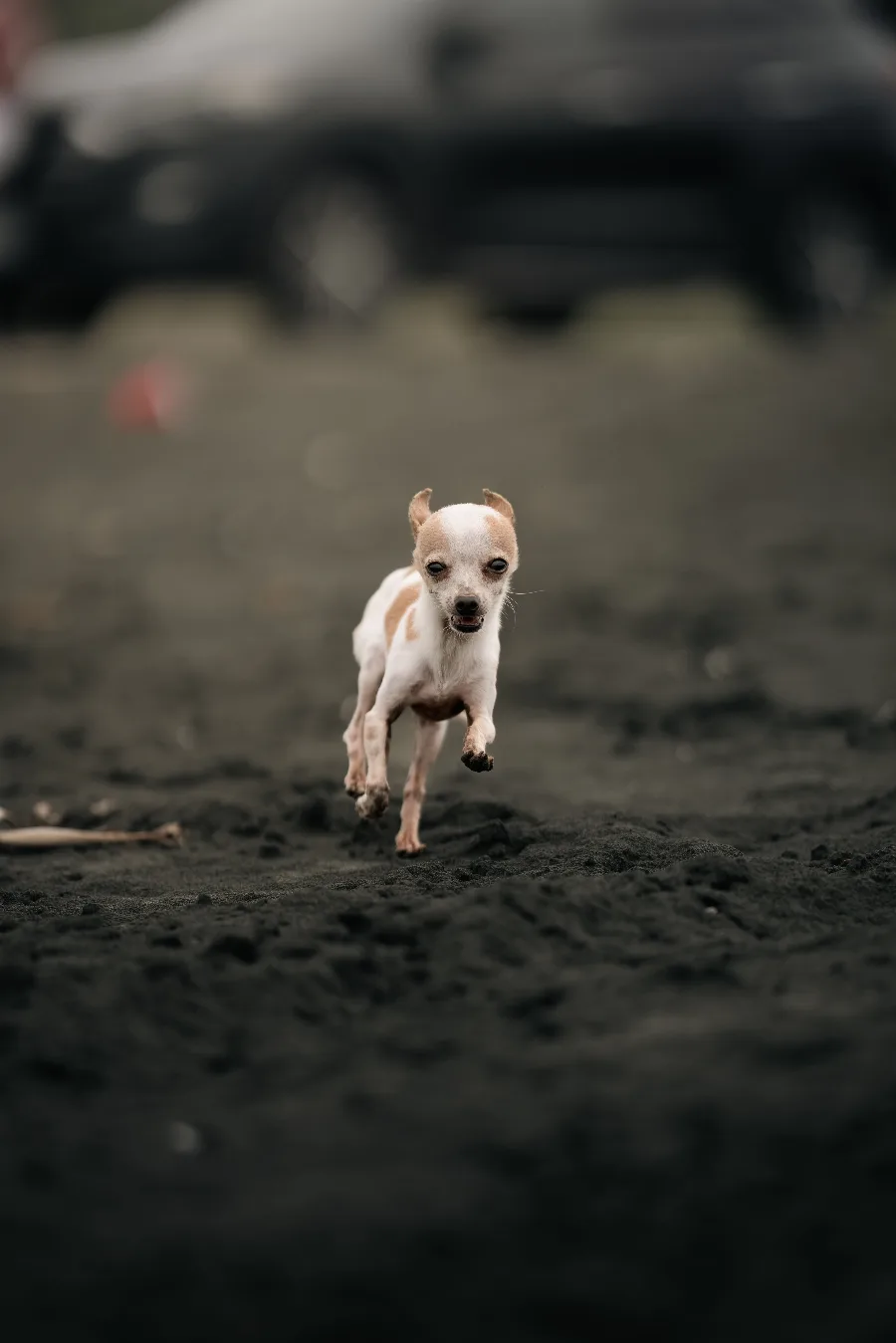
Left without games, a chihuahua invents her own, and her repertoire runs to window-barking marathons, tissue excavation, and ankle patrol. Play is not a bonus for this breed; it is the exercise plan, the brain work, and half the training program traveling in disguise. A dog this size needs no yard and no special equipment: a hallway, pea-sized treats, and ten minutes twice a day cover the whole curriculum. Here are the games worth playing, sized for small joints and a large brain.
Quick answer: Play is not a bonus for this breed; it is the exercise plan, the brain work, and half the training program in disguise, and a chihuahua left without games invents her own, usually window barking or ankle patrol. Two or three sessions of a few minutes each alongside daily walks works well. A hallway, pea-sized treats, and ten minutes twice a day cover the whole curriculum, and nearly every game, find it, scatter feeding, hide and seek, tug on small-dog rules, works in an apartment.
Why games matter at four pounds
The AKC's breed profile calls the chihuahua an alert, amusing companion with a huge personality, which is accurate and also a warning: alertness with no assignment becomes surveillance, and personality with no outlet becomes commentary. Games give all that wattage a job.
They are also the cheapest behavior insurance available; the ASPCA's enrichment guide makes the point that satisfying a dog's instincts to chase, sniff, and chew up front prevents the unwanted versions later. A few short sessions meet much of the daily activity target in our exercise guide, build the engagement that every cue in our basic cues guide runs on, and drain the battery that would otherwise power the seven o'clock barking shift.
Sniffing games: the biggest return on ten minutes
Start here, because nose games suit every age, weather, and knee status. The evidence is encouraging: in a 2019 study in Applied Animal Behaviour Science, Duranton and Horowitz gave 20 pet dogs two weeks of either nosework or heelwork, then measured how quickly each group approached an ambiguous food bowl; the nosework dogs got faster, a standard measure of optimism in welfare research. Twenty dogs is a small sample, so treat the finding as suggestive, but it points the same way as trainers' experience: searching for food by nose is deeply satisfying work.
Find it is the entire franchise in two words. Say the cue, toss a treat where she can see it land, and let her claim it. Over days, toss into longer grass or behind a chair leg, then graduate to hiding pieces around a room while she waits behind a door. Raise difficulty one notch at a time; if she quits, you skipped a notch.
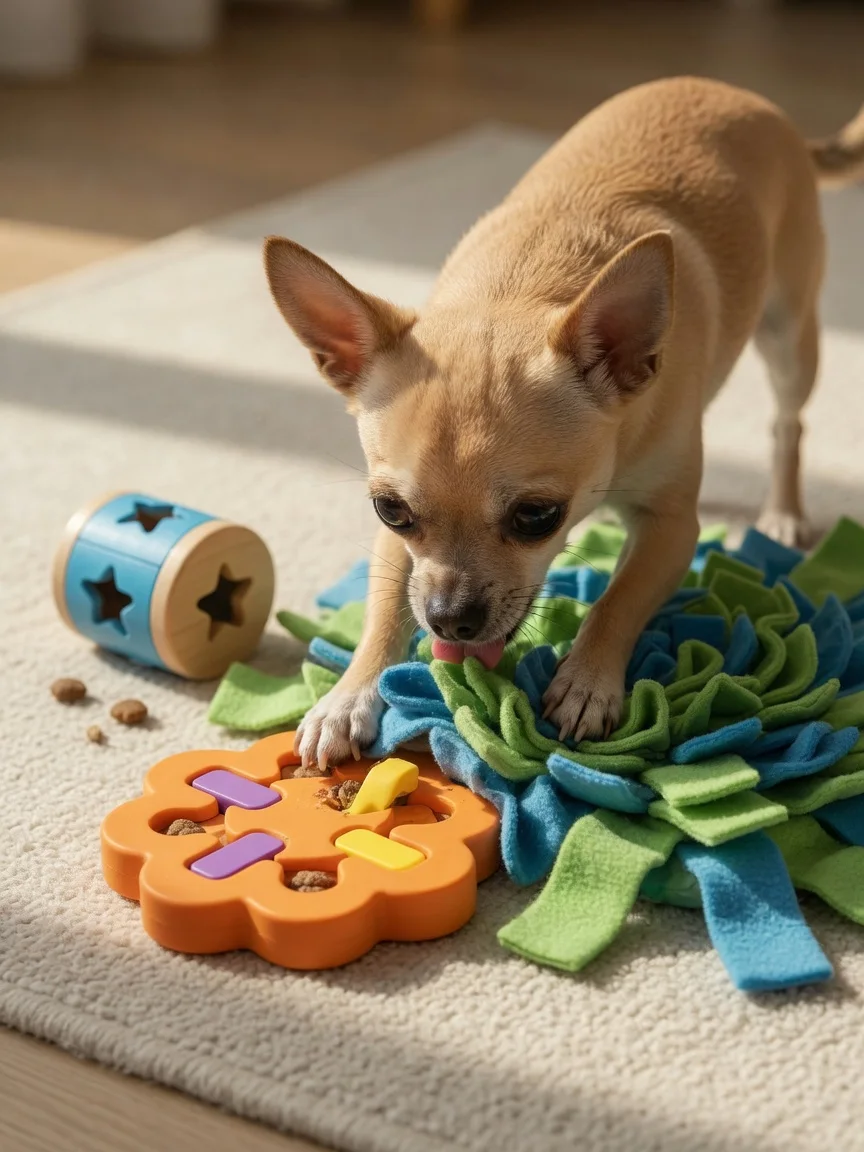
Scatter feeding turns dinner into a hunt: kibble across a snuffle mat, a towel folded over treats, or the muffin-tin puzzle from the ASPCA guide, with food hidden in the cups under a layer of balls. The shell game, one treat under one of three cups, is pure brain work for a rainy Tuesday. And hide and seek, where a person slips behind a door and calls her name once, pays your recall cue in the currency of triumph.
Moving games: fetch, tug, and recall races
Fetch at this size is a hallway sport: a soft, small ball rolled along the floor rather than bounced off furniture, short sprints, and skidding stops on rugs instead of tile. Tug is safe and useful when you hold the rules: keep the toy low, let her do the pulling while your hand stays quiet, never lift her off the floor by the grip, and skip the side-to-side shaking, because a chihuahua neck is not built for it. Trade the toy for a treat to teach drop, and ignore the old warning that letting her win breeds dominance; winning makes the game reinforcing, which is why it works.
Recall races need two people, two treat pockets, and a hallway: take turns calling her, pay every arrival generously, and you are drilling the most important cue she owns at a dead run. Chase works in one direction only: you run away and she pursues, which strengthens coming to you; chasing her teaches a lightning-fast game of keep-away you will regret at the front door.
A flirt pole, a toy on a rope on a stick, packs real exercise into a small room; keep it low, slow, and on grippy footing, because whiplash turns and vertical leaps are exactly what the loose kneecaps in our patellar luxation explainer do not need.
House rules for small-dog play
A few habits keep the fun cheap. Keep sessions short, roughly two to ten minutes, and end while she still wants more; a dog who gets frantic, grabby, or shouty is over her arousal threshold and needs a sniffing break, not a louder game. Pay from the food budget: game treats come out of the daily ration our weight guide defends, because a four-pound dog can eat her way to trouble one liver snap at a time.
Choose toys sized for her mouth, skip any game that asks her to leap off furniture, and supervise children, who play at child speed. Rotate the lineup: five games beat one ground into boredom, a principle our indoor happiness guide builds a whole routine around. And if she declines to play at all, or quietly drops a game she used to love, treat that as information: pain, sore teeth, and illness end play before they end appetite, and a veterinary visit comes before a new toy.
Frequently asked questions
How much playtime does a chihuahua need each day?
There is no fixed prescription. A workable pattern is two or three game sessions of a few minutes each, alongside daily walks; the exercise guide covers the totals by age and health. Watch the dog rather than the clock: a chihuahua who settles easily in the evening is getting enough, and one who patrols and barks probably needs another round of find it.
Is tug of war safe for chihuahuas?
Yes, with small-dog rules: toy held low, she does the pulling, no lifting or shaking, and the game pauses the instant teeth touch skin. Tug does not cause dominance or aggression; that claim has no good evidence behind it. Played with a drop cue and a calm restart, tug teaches more self-control than most formal exercises.
What games can I play with a chihuahua in a small apartment?
Nearly all of them: find it, scatter feeding, the shell game, hallway fetch, hide and seek, and short flirt-pole sessions on a rug all fit in one room. Sniffing games are also the quiet option, which your neighbors will appreciate more than a squeaky-toy tournament.
My chihuahua ignores toys. Is something wrong?
Probably nothing: play style varies by individual, and many chihuahuas rank food and social games far above objects. Start with sniffing games, make toys move like prey with a flirt pole or a dragged string, and keep sessions under five minutes. If a formerly playful dog goes flat, book a veterinary check; losing interest in play is an early and underrated sign of pain.
The best part of a games habit is what it quietly buys you: a recall with mileage on it, a drop cue you never argue about, a dog tired enough to nap through your afternoon calls, and a standing agreement that you are the most interesting thing in the room. Ten minutes in the morning, ten in the evening, cheese in the pocket. She brings the enthusiasm; you bring the hallway.

No comments yet
Leave a comment